There are few British comedies as culturally embedded as Fawlty Towers. First broadcast in 1975, the original sitcom by John Cleese and Connie Booth achieved something close to television immortality across just twelve episodes. Nearly fifty years later, Fawlty Towers – The Play, adapted by Cleese himself and now touring the UK following a successful West End run, arrives at the Regent Theatre with enormous affection already built into the audience experience.
This is less a reinvention than a celebration; a theatrical love letter to one of Britain’s most beloved sitcoms.Rather than presenting a new narrative, the stage adaptation cleverly entangles three classic episodes – The Hotel Inspector, The Germans, and Communication Problems – weaving them into a single evening of escalating farce. The result feels structurally familiar, almost comfortingly so. Audiences who know the series will recognise lines before they arrive, anticipate comic rhythms, and delight in watching iconic moments recreated live. And that is precisely the production’s intention.
This is not a reinterpretation designed to modernise Fawlty Towers. Instead, it functions as a theatrical preservation of television history, carefully transferring the mechanics of sitcom comedy onto the stage. The newly added finale attempts to give the evening theatrical closure, though the real satisfaction comes from revisiting the chaos of Torquay’s most dysfunctional hotel rather than discovering anything dramatically new.
The touring company proves uniformly excellent. Casting here is not about impersonation alone but about capturing comic energy and every performer rises to the challenge.
Danny Bayne’s Basil Fawlty walks a fine line between homage and performance. He channels Cleese’s physicality, manic timing, and barely suppressed rage without descending into caricature. The famous eruptions of frustration land with precision, drawing laughter through rhythm rather than imitation.

Joanne Clifton brings warmth and grounded intelligence to Polly, anchoring the chaos with quiet comic assurance. Opposite her, Mia Austen’s Sybil commands the stage with effortless authority, delivering razor-sharp put-downs that consistently puncture Basil’s delusions.
Hemi Yeroham’s Manuel earns some of the evening’s biggest laughs, demonstrating impeccable physical comedy and timing, while Neil Stewart as the Major provides a masterclass in character comedy, balancing absurdity with charm.
Across the ensemble, there is not a weak performance. Every role, however brief, contributes to the accelerating comic machinery.
Director Caroline Jay Ranger demonstrates an exceptional understanding of theatrical comedy. Farce lives or dies by pace, and Ranger keeps the production moving with relentless precision. Doors slam, misunderstandings compound, and comic beats are allowed just enough space to breathe before the next catastrophe arrives.
The choreography of chaos feels meticulously engineered. Timing is everything here, and the direction ensures laughter builds cumulatively rather than relying solely on nostalgia. Yet it is also clear that much of the humour depends on audience recognition. The biggest laughs often arrive not because jokes are new, but because they are remembered.
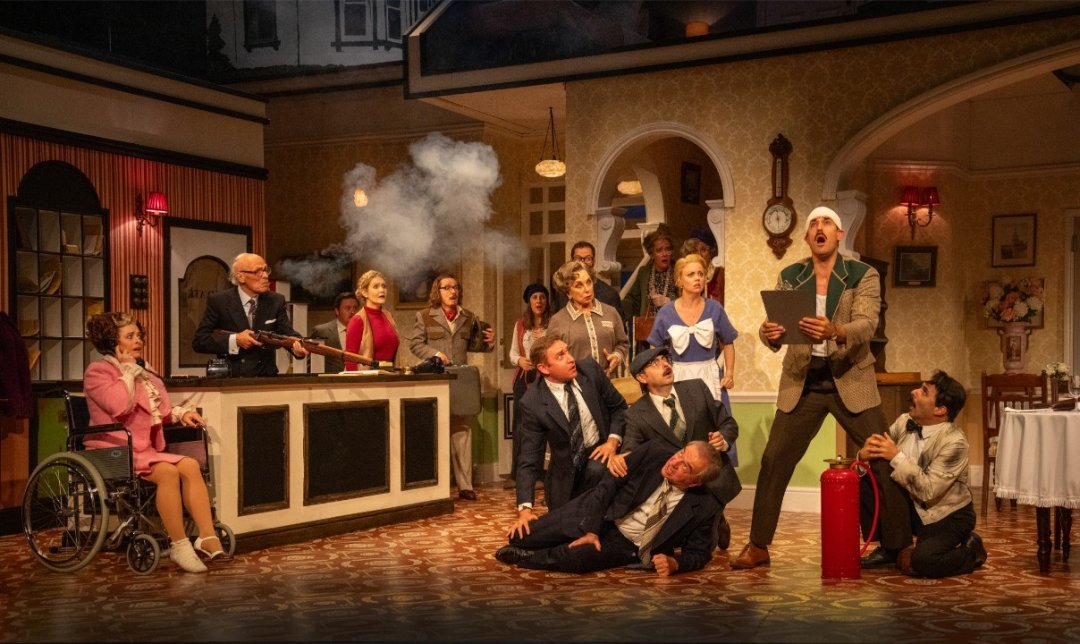
The design work is outstanding. Liz Ascroft’s set and costume design recreates the world of the original BBC series with remarkable fidelity. The instantly recognisable dining room, reception desk, and hotel interiors appear almost uncannily accurate.
Costumes mirror the television aesthetic without feeling like museum pieces. Lighting by Ian Scott and sound design by Rory Madden support the fast-paced action unobtrusively, allowing performance and timing to remain central.
The production understands that visual authenticity is part of the audience contract: spectators are not simply watching a play; they are stepping back into a shared cultural memory.
If the production has a limitation, it lies in its very faithfulness. Because the play draws so heavily from existing material, the experience prioritises nostalgic pleasure over sustained originality. The evening does not strive to prove itself universally or continuously funny in isolation from its source; instead, it invites audiences to relive beloved moments collectively.
For fans, this is immensely satisfying. For newcomers unfamiliar with the sitcom’s rhythms, the humour may occasionally feel episodic rather than dramatically escalating.
But perhaps that is beside the point. Fawlty Towers – The Play succeeds precisely because it understands its purpose: not to replace the original, but to celebrate it live, communally, and joyfully.
At the Regent Theatre, Fawlty Towers – The Play delivers a polished, expertly performed revival of a national comedy treasure. The cast are faultless, the comic direction assured, and the design lovingly recreates one of television’s most iconic worlds.
This is theatre as shared nostalgia – an evening that reminds audiences why Fawlty Towers remains a cornerstone of British comedy half a century after its debut. It may lean more toward affectionate recreation than groundbreaking theatrical innovation, but when laughter echoes through a packed auditorium, it is hard to argue with its enduring appeal.

Fawlty Towers plays at the Regent Theatre until Saturday 28th February 2026 where it will continue its UK tour.
Photography throughout from
Leave a Reply