
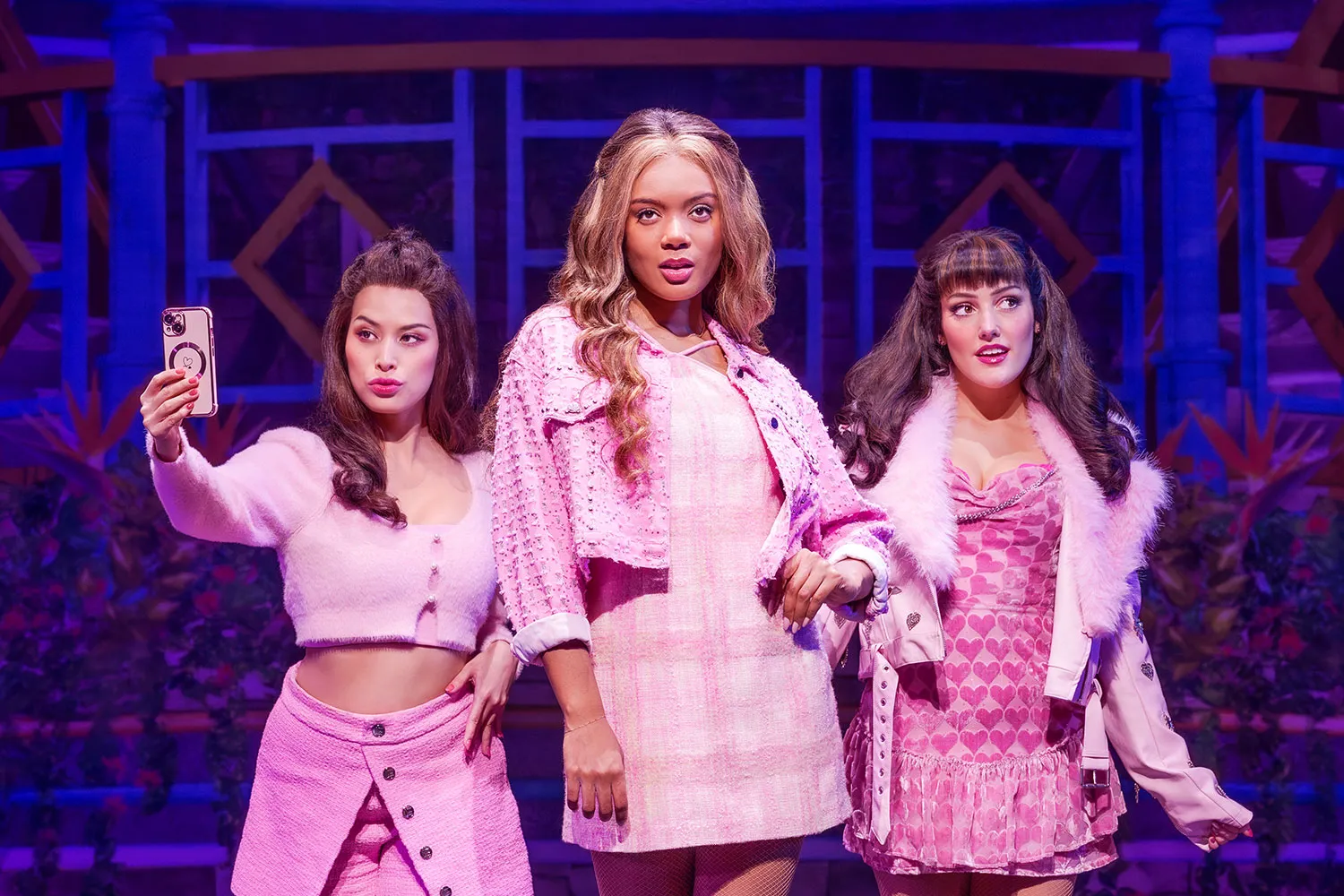
At the Regent Theatre this week, Mean Girls arrives with a slick, high-energy touring production that captures much of the wit and bite of Tina Fey’s original creation, even if some of its design choices fall noticeably short of its West End and Broadway counterparts.
From the outset, this is a cast-led success. Emily Lane’s Cady Heron is a compelling centre, balancing naïve sincerity with a growing sharpness as she is drawn deeper into the toxic ecosystem of North Shore High. There is a clear emotional trajectory in her performance, and she handles Cady’s moral unravelling with subtlety, allowing the audience to remain invested even as the character becomes less likeable. Opposite her, Vivian Panka’s Regina George is every inch the queen bee: controlled, charismatic, and vocally assured. There is a quiet precision to her performance that makes Regina’s manipulation feel calculated rather than cartoonish, which adds an effective layer of menace and keeps the stakes grounded.
Sophie Pourret’s Karen and Max Gill’s Damian are, unsurprisingly, among the biggest crowd-pleasers. The writing of these roles is famously sharp, and this production leans into that strength with confidence. Every punchline lands cleanly, often met with immediate audience response, and both performers demonstrate excellent comic timing without sacrificing vocal clarity. Damian, in particular, becomes a kind of anchor for the audience, guiding them through the chaos with warmth and wit, while Karen’s absurdity is pitched perfectly, never tipping into excess. Their scenes provide some of the show’s most memorable moments.
Sadie Levett brings a grounded, slightly more introspective edge to Janis, which works well against the heightened tone of the surrounding characters. Her performance mixes edgy teen and emotional weight to add to the narrative, particularly in moments where the show interrogates friendship, identity and exclusion. She is vocally exceptional.
The ensemble deserve significant credit for the overall success of the production. They work relentlessly to maintain pace and energy, and their contribution cannot be overstated. The choreography is excellent and executed with precision throughout, often providing the production with a much-needed lift. In fact, it is frequently the ensemble-led numbers that feel the most fully realised, with a cohesion and dynamism that elevate the entire show. These sequences inject a sense of spectacle that compensates, to some extent, for other areas where the production feels scaled back.

Musically, the show offers a mixture of standout moments and less memorable material. There are songs that genuinely soar, showcasing the cast’s vocal strength and adding real momentum to the narrative. However, there are also sections where the score, particularly in Act 2, feels functional rather than distinctive. In these moments, it is the performance quality and staging that carry the material, rather than the music itself leaving a lasting impression.
Where the production falters most noticeably is in its design. The decision to replace the dynamic screen-based set of the West End and Broadway productions with painted curtains is a significant downgrade. The set lacks the fluidity and immediacy that digital elements brought to the storytelling, resulting in transitions that feel slower and less imaginative. At times, the visual aesthetic borders on amateur, which is particularly noticeable in a show so closely associated with a sharp, modern visual identity. This choice diminishes the overall polish of the production and occasionally pulls focus from the performers.
That said, other technical aspects are far more assured. Costume design remains strong throughout, with a clear attention to detail that reinforces character and status. The Plastics are instantly recognisable and consistently styled, while the wider cast are equally well-defined. Props are handled securely and efficiently, contributing to a smooth and uninterrupted performance, and ensuring that the storytelling remains clear.
Directionally, the production understands its strengths. It leans heavily into character and performance, allowing the cast to drive the show rather than relying on spectacle. This proves effective, particularly in a touring context, as it ensures consistency and clarity. However, there are moments where a greater sense of scale or visual ambition would have enhanced the storytelling, particularly in narrative-driven musical numbers where the limitations of the set become more apparent.
Ultimately, this touring Mean Girls is an engaging and thoroughly entertaining production that thrives on the strength of its cast and the energy of its ensemble. While the scaled-back set design prevents it from achieving the visual sophistication of its West End and Broadway iterations, the performances are strong enough to carry the show. It is funny, fast-paced and frequently sharp, delivering a lively night at the theatre that resonates with its audience, even if it occasionally reminds you of the bigger, bolder version it once was.
Mean Girls plays at the Regent Theatre until Saturday 4th April 2026 where it continues its UK tour.

Photography throughout by Paul Coltas
Leave a Reply