
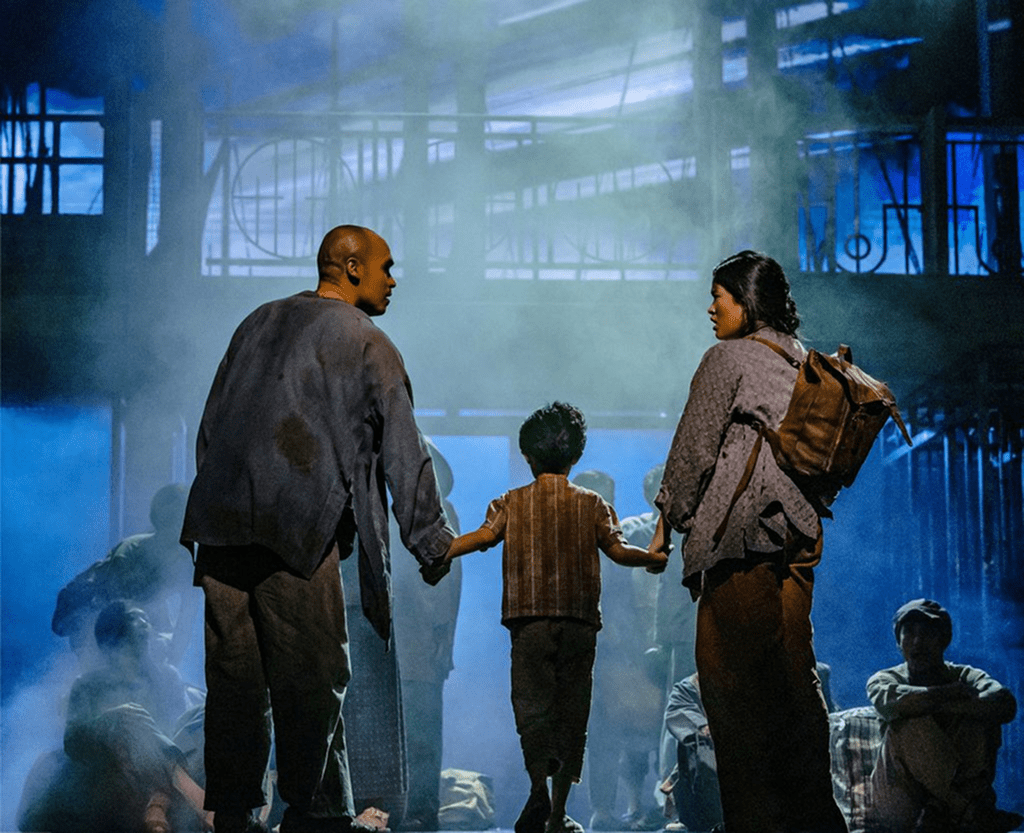
Few musicals arrive with the weight of expectation that accompanies Miss Saigon. Since its premiere, the collaboration between Claude-Michel Schönberg and Alain Boublil has become synonymous with large-scale musical storytelling, emotionally expansive, visually ambitious, and musically demanding. This latest UK tour, overseen by Cameron Mackintosh and directed by Jean-Pierre van der Spuy, embraces that legacy while allowing moments of reinterpretation that feel both contemporary and theatrically justified.
The production design immediately establishes a sense of scale without ever feeling excessive. There is a cinematic fluidity to the staging, aided by carefully integrated video design and lighting that shifts tone and location with impressive clarity. Scenes move swiftly from the neon-lit intensity of Saigon’s bars to the colder, more restrained spaces of America, with transitions that feel purposeful rather than decorative. The lighting, in particular, is used with precision. Harsh, fragmented beams during moments of conflict contrast sharply with the softer, more intimate washes that accompany Kim’s personal journey. It creates a visual language that mirrors the emotional trajectory of the narrative.
What is perhaps most striking across the evening is the discipline and cohesion of the ensemble. The choreography, shaped by Chrissie Cartwright and Carrie-Anne Ingrouille, is executed with remarkable sharpness, particularly within the military sequences. These moments are not only visually impressive but dramaturgically effective. The rigid, synchronised movement reinforces the mechanised, impersonal nature of the conflict, while the increasing urgency of the staging during the evacuation scenes captures a palpable sense of chaos. Every gesture feels intentional, contributing to a production that is consistently tight and controlled.
At the centre of the production is Julianne Pundan’s Kim, a performance that anchors the emotional core of the piece with impressive maturity. Pundan resists the temptation to overplay the tragedy of the role, instead building a character defined by quiet resilience and unwavering hope. There is a sincerity to her portrayal that makes Kim’s circumstances feel immediate and personal rather than purely symbolic. Vocally, she is consistently assured, delivering the score with clarity and emotional precision. Her phrasing allows key moments to breathe, ensuring that the character’s inner life remains at the forefront of each number. The result is a portrayal that feels deeply human, fragile at times but never passive.

Opposite her, Daniel J Brian offers a Chris that is vocally refined and dramatically grounded. His performance avoids the more overtly heroic interpretations of the role, instead presenting Chris as conflicted and emotionally uncertain. This approach proves effective, particularly in the quieter moments where the character’s internal tension is allowed to surface. Vocally, Brian is controlled and expressive, with a tone that complements Pundan’s beautifully in their duets. Their shared scenes carry a genuine sense of connection, which is crucial in sustaining the emotional stakes of the narrative.
The most distinctive interpretative choice comes in the portrayal of The Engineer by Seann Miley Moore. This performance leans into a queer-coded characterisation that feels both deliberate and layered. Moore brings a flamboyant energy to the role, but it is never superficial. Beneath the wit and theatricality lies a clear sense of survival instinct and self-awareness. This approach adds complexity to a character who can often feel tonally detached from the central narrative. The inclusion of ad-libbed references, including a sharp and unexpected nod to Jennifer Coolidge, injects a contemporary humour into The American Dream. Crucially, these moments never disrupt the integrity of the piece. Instead, they enhance its satirical edge, reinforcing the absurdity and desperation underpinning the character’s ambitions.

The supporting cast contribute to a production that feels consistently strong across the board. Dominic Hartley-Harris’s John provides a steady, authoritative presence, grounding the more overtly political elements of the story with clarity and conviction. Emily Langham’s Ellen is handled with notable sensitivity. Rather than positioning the character as an obstacle, Langham presents her as thoughtful and emotionally perceptive, which adds nuance to the relationships at play. Mikko Juan’s Thuy carries an undercurrent of controlled menace, while Thao Therese Nguyen’s Gigi brings both presence and vocal strength to her scenes.
The ensemble remains one of the production’s greatest assets. Their work is not limited to technical precision. There is a clear sense of collective storytelling that elevates every scene in which they appear. Whether navigating the frenetic energy of the bar sequences or the heightened tension of the evacuation, they create a vivid and immersive environment that supports and enhances the principal performances.
Ultimately, this production of Miss Saigon succeeds because it balances spectacle with emotional integrity. It delivers the scale audiences expect, but never at the expense of character or narrative clarity. With a central performance of genuine depth from Pundan, a vocally assured and nuanced Chris, and a refreshingly reimagined Engineer, this UK tour feels both faithful to the original and newly energised.
Miss Saigon plays at the Theatre Royal Nottingham until 4th April 2026 where it continues its UK tour.

Photography throughout from Danny Kaan.
Leave a Reply