There is an undeniable energy pulsing through Sunny Afternoon, the Olivier Award-winning jukebox musical built around the catalogue of The Kinks. Now touring the UK and stopping this week at the Regent Theatre, this production leans heavily into its greatest strength: the sheer musicality of its actor-muso cast.
Sunny Afternoon charts the rise of The Kinks, focusing primarily on Ray Davies as he navigates fame, creative pressure, and the fracturing relationships within the band. Set against the backdrop of 1960s Britain, the show touches on key moments such as the band’s early chart success, their ban from touring the United States, clashes with management and unions, and the personal toll of sudden stardom. However, rather than following a tightly structured narrative arc, the story unfolds episodically, interweaving biographical detail with the band’s back catalogue. This can leave the plot feeling diffuse, as multiple strands including personal, professional, and political elements are introduced but not always fully explored.
In terms of its production history, Sunny Afternoon began life at Hampstead Theatre in 2014 before transferring to the Harold Pinter Theatre in the West End, where it enjoyed a successful run and won four awards at the Laurence Olivier Awards, including Best New Musical and Outstanding Achievement in Music for Ray Davies. With a book by Joe Penhall and music and lyrics by Ray Davies, the show has since toured the UK, bringing its distinctive actor-muso format and celebration of one of Britain’s most influential bands to a wider audience.
From the outset, the strength of the leads is unmistakable. Danny Horn as Ray Davies delivers a performance that is both musically assured and dramatically nuanced, capturing the introspective, often conflicted nature of Davies with quiet control. His vocal performance is particularly strong, anchoring the show’s most iconic numbers with clarity and emotional weight. Alongside him, Oliver Hoare’s Dave Davies provides an excellent counterbalance that is more volatile, impulsive, and physically expressive. Together, they establish a compelling central dynamic that gives the production much of its dramatic credibility, even when the script itself lacks focus.

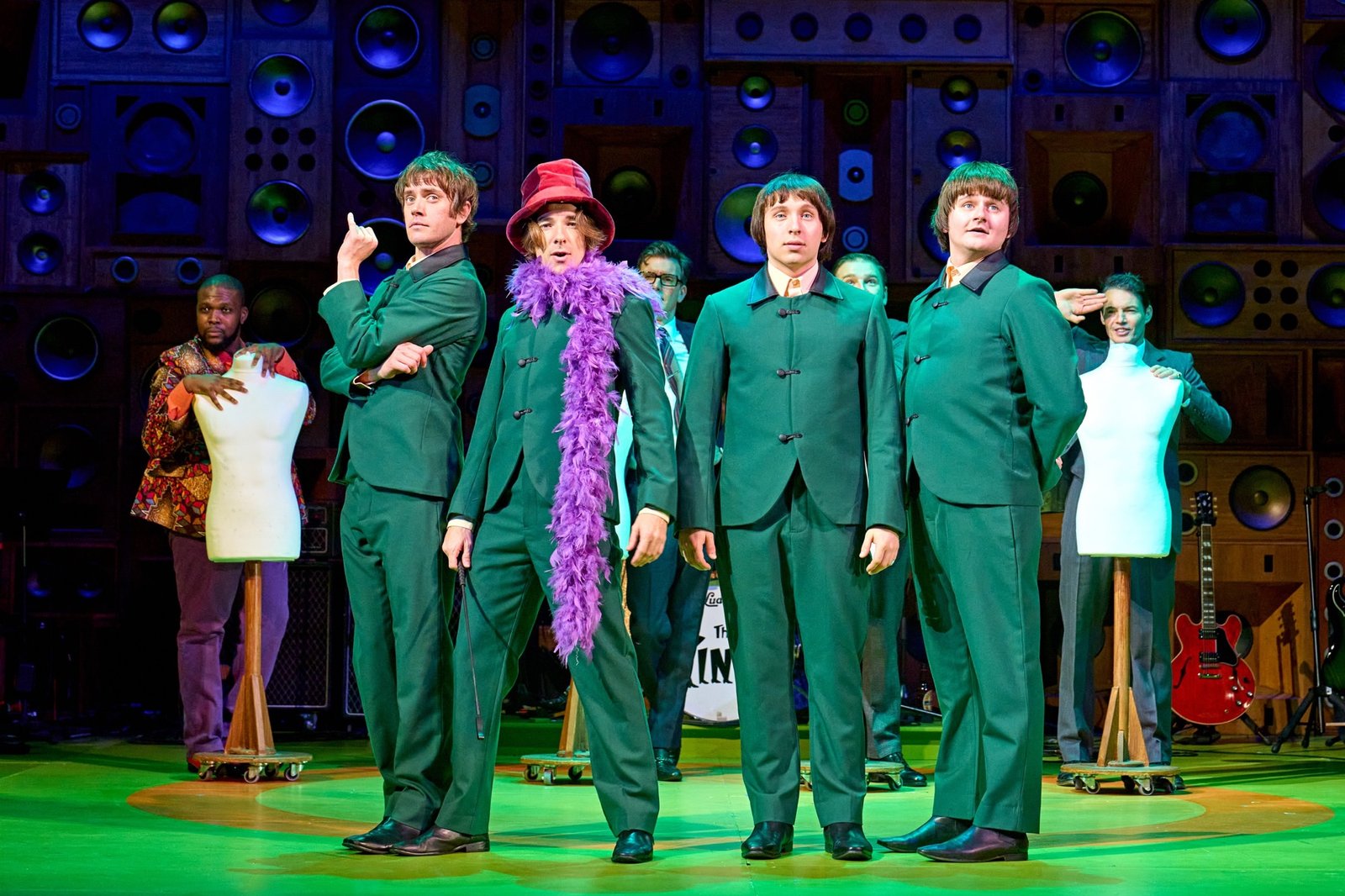
The central quartet, completed by Harry Curley and Zakarie Stokes, are musically tight and stylistically confident. The decision to use actor-musicians pays dividends, with band sequences that feel authentic, immediate, and thrillingly live. Numbers such as “You Really Got Me” and “All Day and All of the Night” land with real punch, capturing the raw, rebellious spirit that defined the band’s early sound.
Vocally, the cast are consistently strong, and musically the show rarely falters. The arrangements retain the grit of the originals while adapting effectively for the stage, and the sound design ensures clarity without sacrificing impact. Quite simply, the music sounds excellent, and it is this that carries much of the evening.
Visually, the production is anchored by a striking set: a mosaic wall of speakers, punctuated by a recording studio window. It is a bold, effective design that immediately situates the audience within the band’s creative world. However, while aesthetically pleasing, it remains largely static throughout. There is little sense of visual evolution, and as the narrative attempts to span multiple phases of the band’s career, the lack of transformation in the set becomes more noticeable.
Where the production feels less assured is in its storytelling. The book, by Joe Penhall, struggles to balance the competing demands of biographical narrative and jukebox musical structure. The result is a plot that feels somewhat meandering, pulled in multiple directions without fully committing to any single thread.
Key elements such as Ray’s relationship with Rasa, the band’s internal tensions, union disputes, legal battles with record labels, and Dave’s personal identity are all introduced but rarely developed with depth. These strands appear briefly before giving way to the next musical number, creating a sense of fragmentation rather than progression. There is no clear narrative through-line or culminating objective, which ultimately limits the emotional payoff.
That said, the performances themselves remain grounded and secure throughout. Even when the script falters, the cast, led by two particularly strong central performances, maintain a convincing sense of character and cohesion. Supporting roles, including Victoria Anderson as Gwen and Lisa Wright as Rasa, offer glimpses of more emotionally resonant material, though these moments are often too fleeting to fully land.
Technically, the production is polished. Lighting design subtly enhances mood and era, costumes effectively evoke the shifting styles of the 1960s, and choreography injects energy into ensemble numbers without ever feeling overbearing. These elements work cohesively to support the musical sequences, even when the narrative lacks focus.
Ultimately, Sunny Afternoon is a show that thrives as a live music experience but struggles as a piece of drama. It celebrates the sound and spirit of The Kinks with undeniable flair, powered by a hard-working and highly talented cast and anchored by two particularly compelling leads. However, its storytelling feels underdeveloped, leaving the audience with a collection of moments rather than a fully realised journey.
For fans of the music, it is an enjoyable and often exhilarating night at the theatre. For those seeking a tightly woven narrative, it may feel like a show still searching for its centre.
Sunny Afternoon plays at the Regent Theatre until Saturday 11th April 2026 where it continues its UK tour.

Photography throughout from Manuel Harlan.
Leave a Reply