Spring has come again as Hadestown welcomes a new cast for its third year in London. With a stellar new cast and a hypnotically beautiful score, Hadestown remains the jewel in the crown of musical excellence in the West End; it is not only a theatrical spectacle but also a testament to the rich tapestry of British talent. The production seamlessly weaves together elements of ancient Greek mythology with modern storytelling, all while showcasing the diverse range of accents and cultural influences that define contemporary Britain.
Hadestown is a captivating musical that intertwines two mythic love stories against the backdrop of a post-apocalyptic world. Set in the underworld ruled by the enigmatic Hades and his wife Persephone, the narrative follows the journey of Orpheus, a gifted musician, as he descends into the depths of despair to rescue his beloved Eurydice. Along the way, the audience is immersed in a world where gods and mortals collide, where love and redemption are sought amidst the darkness, and where hope and despair dance in a delicate balance. Through its mesmerising music, compelling characters, and timeless themes, Hadestown invites audiences to contemplate the power of love, the resilience of the human spirit, and the eternal struggle between light and shadow.

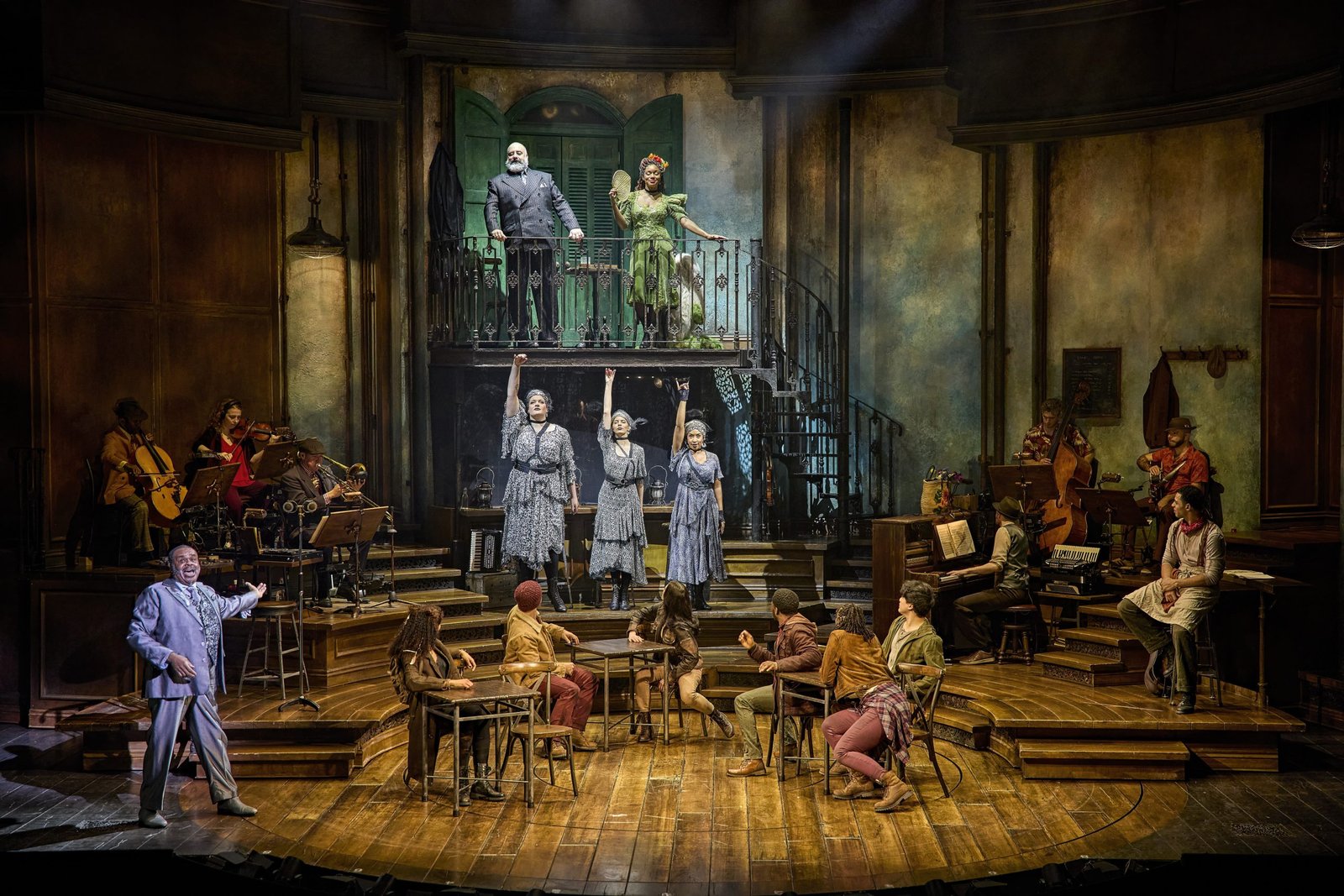
Clive Rowe leads the cast with confidence, charm and astonishing vocals as Hermes. Flawless from start to finish, he commands the stage with an effortless authority that immediately establishes trust between performer and audience. His Hermes is not simply a narrator but a knowing guide, steeped in warmth and wisdom, with a playful glint that keeps the storytelling alive and immediate. Vocally, Rowe is exceptional: his tone is rich, resonant and full-bodied, sitting comfortably across the score’s jazz-inflected demands. He shapes phrases with musical intelligence, often leaning into syncopation to enhance the storytelling. His physicality is equally considered: relaxed yet purposeful, moving with a natural ease that contrasts effectively with the rigidity of the underworld. It is a masterclass in musical storytelling, anchoring the entire production.
Marley Fenton delivers a beautifully judged Orpheus, leaning fully into the character’s innocence and naive idealism without allowing him to become insubstantial. His portrayal foregrounds Orpheus as an artist first and foremost, a dreamer whose belief in music as a transformative force feels entirely genuine. Vocally, Fenton is outstanding. His tenor is light, clear and remarkably controlled, with an almost choral purity that gives his sound an otherworldly quality. His upper register, in particular, is handled with impressive ease, never sounding strained, and he uses dynamic variation intelligently to build emotional intensity across his key numbers. Dramatically, his stillness is a strength: rather than overplaying, he allows the character’s sincerity to speak for itself. This restraint makes his moments of desperation all the more powerful, particularly as the stakes heighten in Act 2. His Orpheus feels fragile, but never weak – an important distinction that ensures the character retains emotional credibility.
Rachel Adedeji is a commanding and deeply nuanced Persephone. From her first entrance, she brings an infectious energy that cuts through the darkness of Hadestown, embodying the spirit of the natural world in contrast to the mechanical rigidity of the underworld. Her vocal performance is exceptional: warm, soulful and effortlessly powerful, with a flexibility that allows her to shift seamlessly between playful phrasing and raw, emotional intensity. She has a natural instinct for musical storytelling, often using subtle tonal shifts to reflect Persephone’s internal conflict. Dramatically, Adedeji excels in presenting Persephone as a figure caught between worlds – her joy tinged with melancholy, her defiance underpinned by exhaustion. Her interactions with Hades are particularly compelling; she balances frustration, affection and long-standing hurt with remarkable clarity, making their relationship feel lived-in and complex. It is a performance full of texture, vitality and emotional truth.
Alastair Parker’s Hades is a triumph of controlled intensity. He avoids the trap of presenting the character as purely authoritarian, instead crafting a portrayal that is grounded, human and quietly devastating. His vocal delivery is dark, weighty and deliberate, with a beautiful gravelled quality that reinforces the character’s authority while also hinting at emotional fatigue. Parker’s northern accent carries a tough exterior which makes his character arc even more convincing and genuinely moving. This creates a Hades who is both imposing and introspective. What elevates the performance is the emotional layering; moments of vulnerability are not overplayed but emerge subtly, particularly in scenes with Persephone. The result is a portrayal that feels deeply authentic – a ruler hardened by time, yet still capable of feeling.
Bethany Antonia offers a thoughtful and emotionally detailed Eurydice. Vocally, Antonia demonstrates impressive control, particularly in her softer passages where she employs delicate phrasing and well-judged opt-downs to create intimacy. Her tone is warm and expressive, and she uses breath effectively to shape emotional nuance within lines. Dramatically, she is particularly strong in reactive moments – her listening is active and engaged, which enriches her interactions with Orpheus and Hades alike.

The Fates – Melanie Bright, Lauran Rae and Spike Maxwell – are precise, controlled and deeply atmospheric. Their vocal blend is exceptional, achieving a tight harmonic unity that feels both polished and unsettling. They operate almost as a single entity, yet each performer brings subtle individuality through physical detail and tonal variation. Their movement is fluid and intentional, often mirroring or counterpointing the action in ways that heighten tension. What stands out is their consistency: every entrance feels purposeful, and their presence maintains a constant undercurrent of inevitability. They do not simply comment on the action, they shape it.
The Workers, portrayed by Gabriela Benedetti, Femi Akinfolarin, Michelle Andrews, Ollie Bingham and Sebastian Lim-Seet, deliver a cohesive and physically demanding ensemble performance that underpins the entire production. Their movement is sharp, synchronised and rhythmically precise, reflecting the industrial world they inhabit. Vocally, they provide a strong, unified sound that contrasts effectively with the more individualised performances of the principals. What is particularly effective is their ability to maintain character within ensemble work: each performer contributes to a collective identity while still suggesting individuality through physical choices and energy. Their presence is essential in grounding the production’s themes of labour, control and resistance, and they execute this with clarity and conviction.

Anaïs Mitchell’s lyrics are nothing short of poetic, weaving together intricate storytelling with rich imagery and metaphor. Each song is a masterpiece in its own right, conveying complex emotions and themes with haunting beauty. Mitchell’s ability to capture the essence of the human experience is truly remarkable, and her lyrics serve as the beating heart of the production.
The creative team behind the West End production of Hadestown is a powerhouse of talent, each member contributing their expertise to bring Anaïs Mitchell’s visionary project to life on stage. Led by director Rachel Chavkin, the team has crafted a production that seamlessly blends mythic storytelling with contemporary sensibilities, creating a theatrical experience that is both timeless and relevant.
Chavkin’s direction is masterful, guiding the cast and crew with precision and insight to create a cohesive and immersive world onstage. Her ability to balance the epic scope of the story with intimate character moments is evident throughout the production, drawing audiences into the emotional journey of the characters.
Choreographer David Neumann’s work adds an extra layer of dynamism to the production, with his inventive and evocative choreography bringing the world of Hadestown to life in stunning detail. From the haunting movements of the Fates to the vibrant energy of the Workers, Neumann’s choreography enhances the storytelling and adds depth to the characters.
Set designer Rachel Hauck’s vision transforms the stage into a multi-dimensional underworld, with her intricate and innovative designs creating a sense of grandeur and intimacy simultaneously. Her use of space and texture adds depth and richness to the production, transporting audiences to a world that is both fantastical and familiar. The descents and ascents to the underworld are portrayed masterfully and demonstrate an incredible use of staging and set.
Costume designer Michael Krass’s work is equally impressive, with his stunning costumes reflecting the characters’ personalities and the world they inhabit. From the elegant attire of the gods to the rugged garb of the Workers, Krass’s designs help to define the characters and enhance the overall aesthetic of the production.
Lighting designer Bradley King’s contributions are also crucial to the production, with his expert use of light and shadow creating mood and atmosphere onstage. Many moments in the show allow you to truly appreciate this wonderful lighting design – injecting energy at some points and inflicting emotion at others. Shadows are thrown onto the wall as light hits characters in atmospheric moments. The intensity of the lighting in other moments is startling.
Overall, Hadestown is a theatrical tour de force that captivates audiences from start to finish. With its stunning visuals, mesmerising music, and powerhouse performances, it is a testament to the enduring power of storytelling and the boundless creativity of the human spirit. It is a must-see production for fans of musicals, love stories or a high-quality night out.
Hadestown plays at the Lyric Theatre, London and is currently booking up until December 2026.

Photography throughout from Brinkhoff-Moegenburg.
Leave a Reply