Based on Steven Antin’s 2010 film of the same name, Burlesque the Musical has landed in Stoke-on-Trent as part of its first UK tour, arriving with all the promise of powerhouse vocals, jaw-dropping choreography and sequinned, underground-club glamour that made the original such a cult favourite. On the evidence of this performance, though, the show currently has considerably more style than substance: a production with real potential that, at present, feels muddled and unfinished.
The road to the the UK tour has not been steady for Burlesque. Having a successful Manchester and Glasgow run (of which I was fortunate enough to see), the show arrived in London with a new creative team and significant cast changes. Following a successful, if not controversial, run in London, the production has embarked on a new UK tour with yet another new creative team and its third director. Following cancellation of a number of performances both earlier in the run and at the Regent, Burlesque has now opened in Stoke-on-Trent. A polite reminder at this point that it is not the fabulous team at the Regent’s fault that performances have been cancelled, so negativity towards them is not warranted or fair.
The singing is, without question, the strongest thing on offer, and the cast deserve enormous credit for working as hard as they do to paper over the cracks elsewhere. Gracie O’Brien, making her professional stage debut as Ali, delivers a genuinely stunning vocal, a real Aguilera-esque power that fills the room, and her performance remains believable even when the book pushes her character in some distinctly odd directions. Faye Brookes has a lovely voice as Tess, but she doesn’t yet have the stage presence, nor does she seem to have been directed, to carry the weight, status and sheer command that Cher brought to the role on screen, and that this part still demands. Ryan Carter, as Sean, has plenty of vocal power but loses clarity in the moments where the lyrics come thick and fast and the orchestration swells too loud; the bigger problem is that the show itself never seems to decide what Sean is actually for, so the role drifts without real purpose. Elsewhere, the wider company do well with what they’re given, and there isn’t a weak voice on that stage.

All of that vocal talent is doing a lot of heavy lifting, because the writing simply isn’t there yet. Characters are thinly sketched from start to finish, and there’s very little for an audience to actually invest in emotionally, you watch events happen to people rather than caring what happens to them. Anyone who saw earlier iterations of this show will barely recognise large stretches of the plot, which appears to have been pulled apart and hastily reassembled, with coherence sacrificed somewhere along the way. There’s also a baffling surplus of musical numbers, several of which do almost nothing to advance character or story, “Ammo” being a prime offender, and the decision to give every cast member their own song, whether or not the moment has earned it, only dilutes things further. The score itself hops between so many different genres and styles that it never settles into an identity of its own, such as Act Two’s 90s-boy-band-inspired number ‘Natalie’; it borrows the shape of half a dozen musicals without committing to any of them. Structurally, the show’s central conflict is introduced and then fully resolved by the end of Act One or the very start of Act Two, which forces it to manufacture an entirely new set of stakes for the second half. Those new stakes feel thin and are then dispatched almost comically quickly, in what look like book changes made purely to save running time rather than to serve the story.
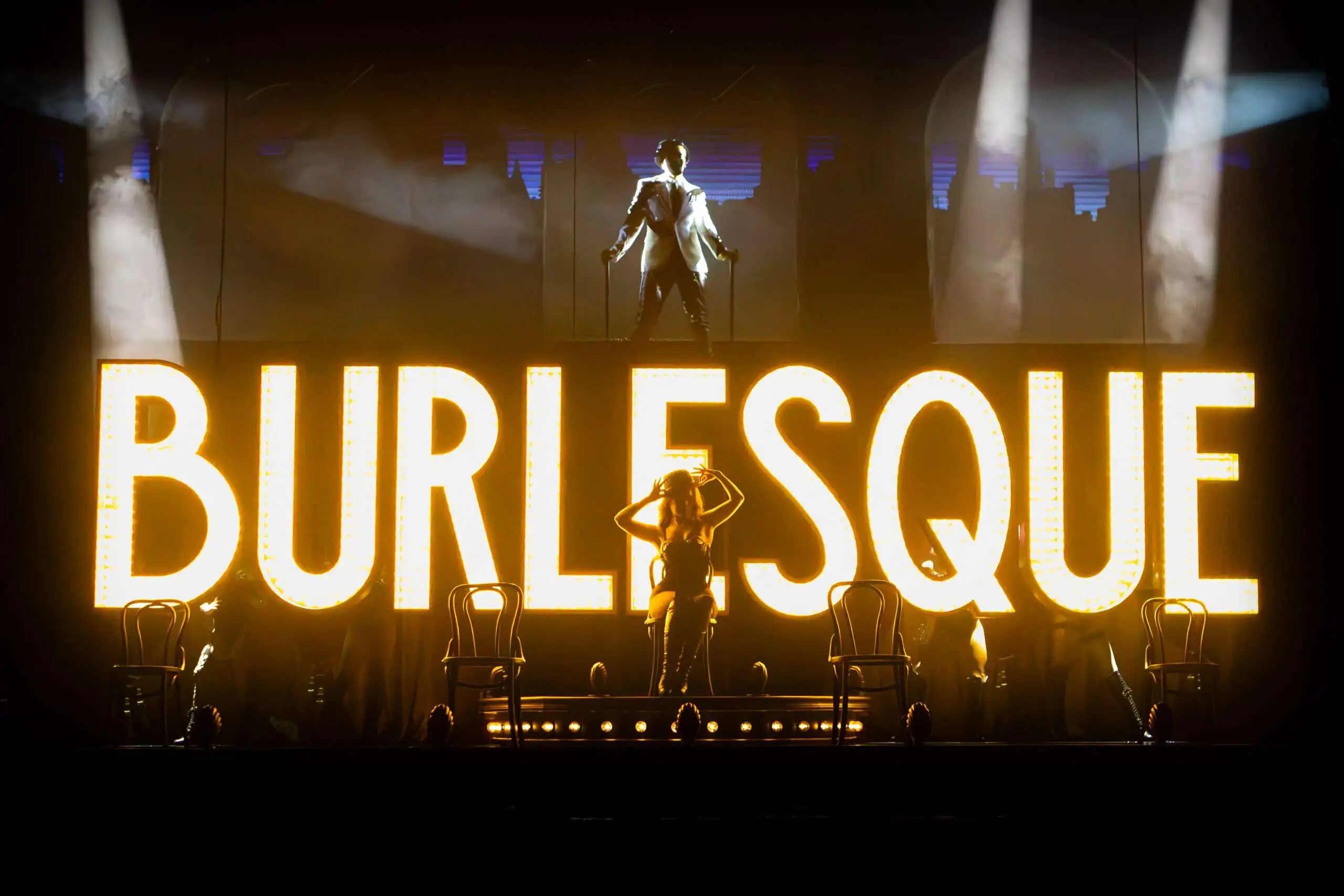
Sara Perks’s set, built largely from moveable pieces, is a good idea that isn’t quite landing yet. It becomes noisy and distracting every time it’s shifted around, breaking the flow of scenes, and one curtain at the back of the stage fails to fully mask a key set piece, meaning stage crew are visible moving things mid-scene. Elsewhere, the set pieces frequently crowd the available playing space, cramping choreography that is, on its own terms, genuinely excellent. The strangest choice by far is a curtain that comes down extremely close to the front of the stage to allow scenes to play out while set changes happen behind it, except this leaves the cast with nowhere to exit to, and nothing can be moved into the wings until it lifts again. Lighting cues were inconsistent on the night, with performers more than once left singing or speaking in the dark, unlit at exactly the wrong moment. The video design, which stands in for scenery and drapes for large stretches of the show, clearly hadn’t been fully bedded in either: stray or mistimed projections repeatedly hammered across the stage and pulled focus from what was actually happening in front of them. As for the choreography, Robin Antin and Aaron Renfree’s work is properly excellent, sharp, inventive, full of attack, but too many numbers go all-out with nothing held back, and without any light and shade the impact of individual moments starts to blur together by the second act.
For all of that, this remains a fun and entertaining night out, buoyed by a hard-working company and a handful of genuinely impressive voices, Gracie O’Brien’s chief among them. But there’s a clear and fairly wide gap between the show Burlesque the Musical clearly wants to be and the show currently on stage at the Regent. The bones of something glittering and powerful are all there, in the voices, in the choreography, in the source material itself; what’s needed now is tighter writing, calmer staging and a technical operation that’s had more time to settle in before it can properly live up to its own ambition.
Burlesque the Musical plays at the Regent Theatre until Saturday 29th August 2026 where it continues its UK tour.

Photography throughout from Rosie Moore The Social Sort.
Leave a Reply