
There is something immediately reassuring about an Agatha Christie adaptation arriving on stage. The promise is clear: intrigue, elegance, and a carefully constructed puzzle that will ultimately snap into place. The UK tour of Death on the Nile, now playing at Nottingham’s Theatre Royal, delivers much of that promise, even if the journey there is not always as smooth as the Nile itself.
Set against the backdrop of a luxurious cruise along the Nile, the story follows a newly married couple whose seemingly perfect honeymoon is shattered by a shocking murder. As tensions simmer among the passengers, it becomes clear that beneath the glamour lies a web of jealousy, betrayal and long-held grievances. Each guest harbours secrets, and many have motives, turning the confined setting into a pressure cooker of suspicion. Fortunately, the renowned Belgian detective Hercule Poirot is on board, and he begins to unravel the intricate relationships and hidden pasts of those involved, methodically piecing together the truth to expose the killer in a final, carefully orchestrated reveal.
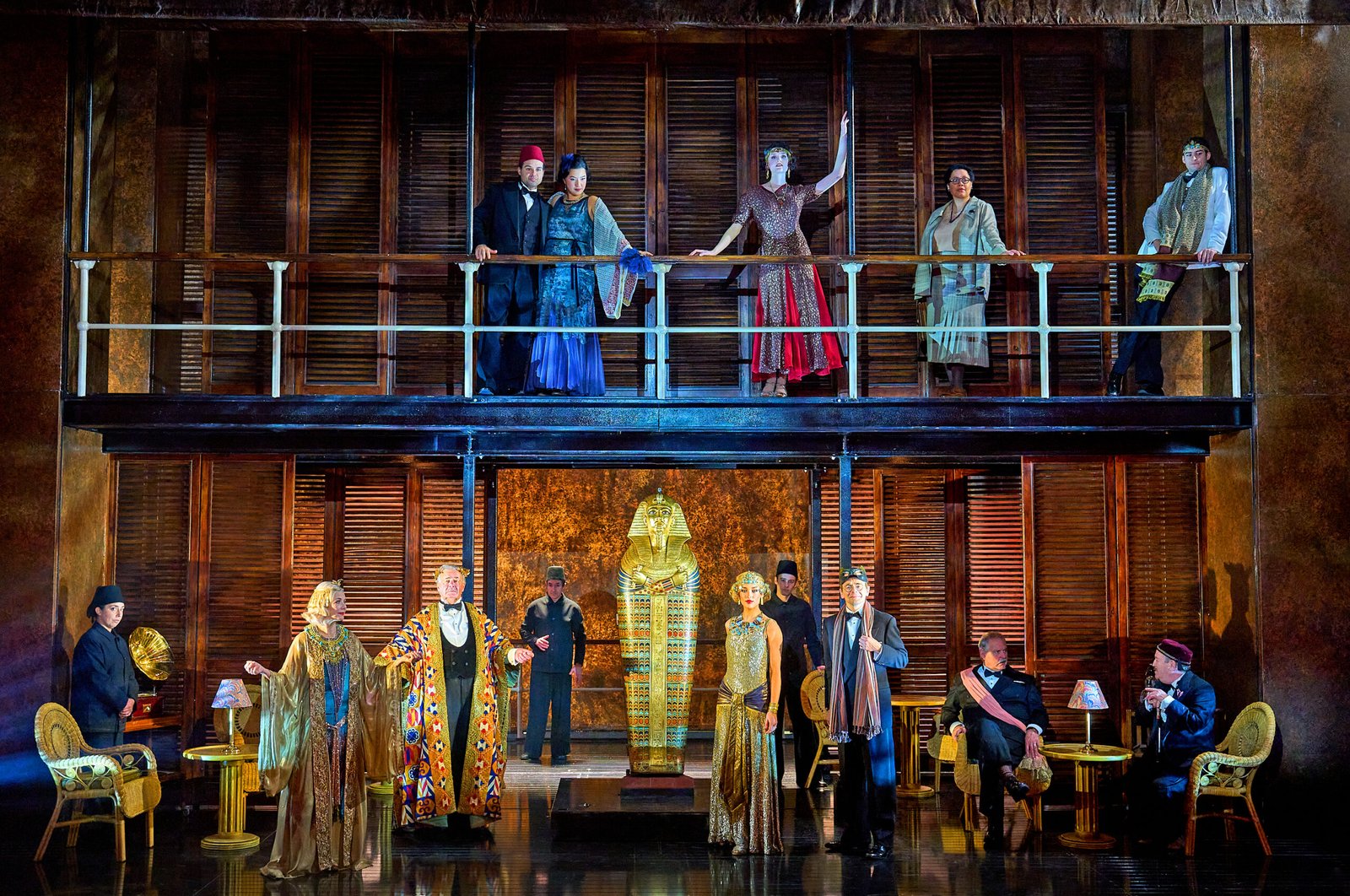
From the outset, the production looks the part. Mike Britton’s set is undeniably striking, conjuring the heat and opulence of Egypt with a fluid design that moves us convincingly between locations. Whether we are aboard the steamer or in more intimate settings, the visual storytelling is confident and atmospheric. Combined with Oliver Fenwick’s lighting and Mic Pool’s sound design, the world feels fully realised, offering the kind of transportive theatre experience audiences expect from a Christie adaptation.
At the centre of it all is Mark Hadfield as Hercule Poirot, who leads the company with ease. His portrayal is measured and assured, capturing Poirot’s precision and quiet authority without tipping into caricature. Even when the script occasionally nudges the character in slightly uncertain directions, Hadfield remains a steady anchor, ensuring Poirot never loses his integrity. It is a performance that understands the importance of control, allowing the detective’s intellect to take precedence over theatrics.

Esme Hough’s Jacqueline de Bellefort is a standout. She brings a compelling intensity to the role, balancing fragility with simmering menace. Her performance is magnetic, giving real emotional weight to a character that could easily become one-note.
The wider ensemble works well to maintain the sense of a closed circle of suspects, each with their own secrets and motives. Ken Ludwig’s adaptation trims some of Christie’s original characters, presumably in an effort to streamline the narrative. In their place, he introduces new figures, including a museum curator with his son and a fading actor, both carrying their own grievances. While these additions are interesting in concept, they contribute to one of the production’s key weaknesses.
The script, at times, feels clunky and uneven. The first act in particular struggles with pacing, meandering through exposition that does not always feel necessary or dramatically engaging. Some of this appears to be a hangover from the novel’s complexity, with the adaptation attempting to retain too much detail without fully integrating it into a cohesive stage narrative. As a result, certain moments feel laboured, and a few lines land awkwardly, veering into the cringeworthy. No amount of direction can fully smooth over dialogue that simply does not ring true.
That said, Lucy Bailey’s direction does much to steady the production. She maintains clarity in the storytelling and ensures that, even when the script falters, the overall shape of the narrative remains intact. The second act, in particular, finds its rhythm, as the plot tightens and the tension builds towards the inevitable reveal.
And this is where Death on the Nile ultimately succeeds. For all its inconsistencies, the core of Christie’s storytelling remains intact. The pleasure of watching the puzzle unfold, of piecing together clues and misdirections, is still very much present. When Poirot gathers the suspects and lays out the truth, the production delivers that familiar and satisfying payoff.
It may not be a flawless adaptation, but it remains an enjoyable night out. There is a reason Christie endures, and even here, with its imperfections, the brilliance of her plotting shines through.
Death on the Nile plays at the the Theatre Royal Nottingham until 18th April when it continues its UK tour.

Photography throughout from Manuel Harlan.
Leave a Reply