
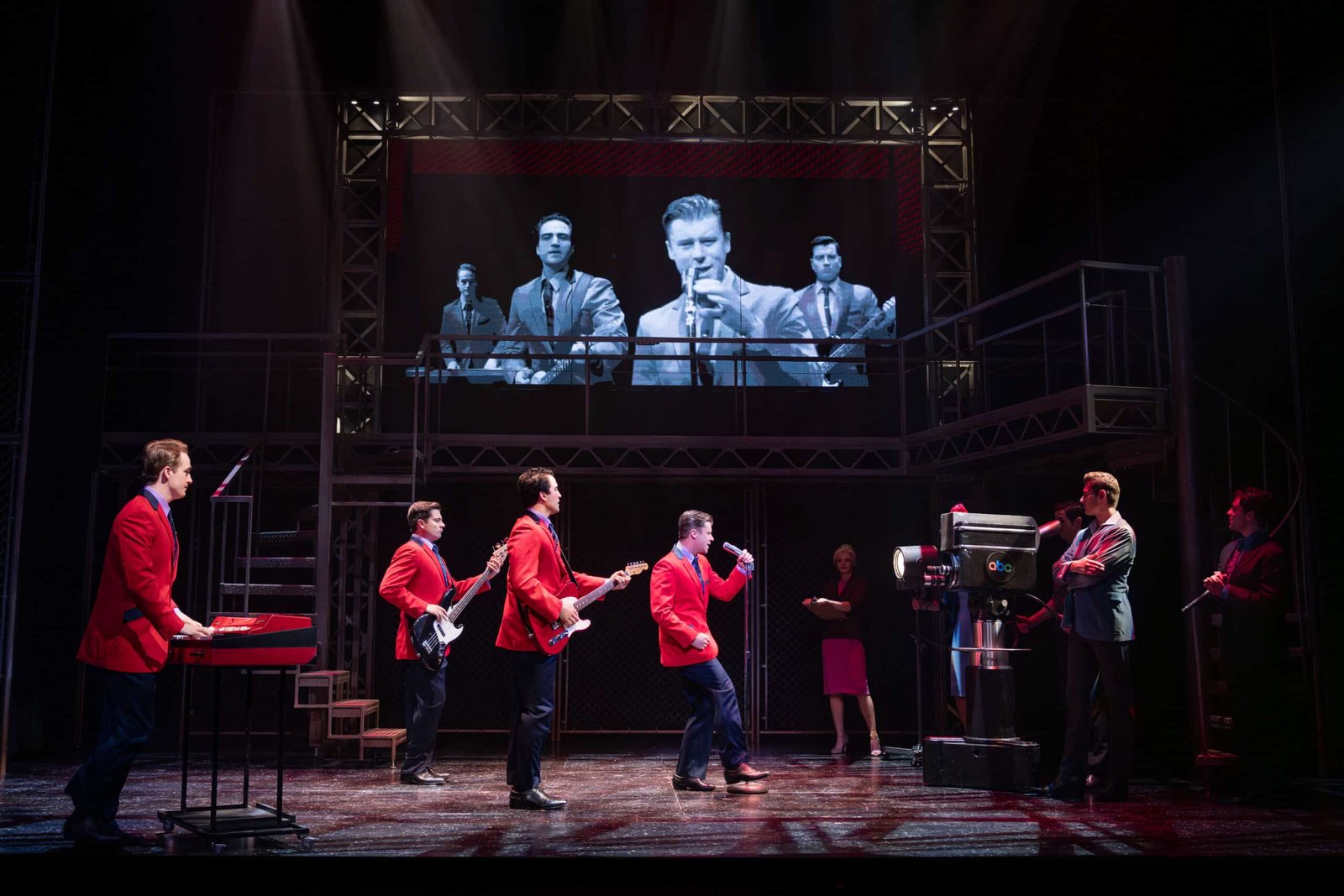
Jersey Boys has been a fixture of the West End and the touring circuit for the best part of two decades, and this 20th anniversary tour shows why it has lasted. Staged by the original Broadway creative team, led by director Des McAnuff and choreographer Sergio Trujillo, it is a slick, confident production that knows exactly what it is doing. The story follows Frankie Valli and The Four Seasons from the streets of New Jersey to the Rock and Roll Hall of Fame, and the score is a run of hits that most of the audience can sing along to: Sherry, Big Girls Don’t Cry, Walk Like a Man, Can’t Take My Eyes Off You, Beggin’ and Oh What a Night. The book has some genuine weaknesses, and I will come to them, but this is a thoroughly enjoyable evening, and the performances are the reason why.
This is a vocally incredible company. The musical demands real singing, with tight, exposed four-part harmony and a lead role that sits in one of the most punishing ranges in musical theatre. The touring cast meets those demands with ease.
Luke Baker is perfect as Frankie Valli. He carries the evening, and his performance holds together the vocal showpiece and the human story underneath it. The falsetto is secure and powerful, and Baker also finds the vulnerability in a man whose career is thrilling and whose personal life is more costly. Given that the show is, first and foremost, Frankie’s story, the production could not work without a lead of this calibre, and it has one.
Carlo Boumouglbay is perfect as Tommy DeVito. Tommy is the group’s founder and its driving force, and the role needs charm and danger in equal measure. Boumouglbay gives us a Tommy whose confidence is magnetic enough to explain why the others follow him, and whose recklessness is clear enough to explain why it eventually comes apart.
Lewis Kennedy is perfect as Nick Massi. Nick can easily be reduced to the quiet one with the dry one-liners, but Kennedy gives the character a real presence, and his deadpan frustration is among the more convincing emotional threads in the first half.
Toby Miles is perfect as Bob Gaudio. As the songwriter who joins the group and shapes its sound, Gaudio is the steady, intelligent centre of the story, and Miles plays him with composure and warmth. The way Gaudio’s partnership with Frankie develops is central to the show’s second half, and Miles gives it weight.
The four work brilliantly as a unit. When they sing together, the blend is exactly what the material needs: precise, energetic and rich. The supporting company and the swings, drawn from a deep pool of West End, touring and international credits, are strong throughout, and the depth of the cast shows in the sound.

The staging is good, and it serves the story rather than competing with it. The digital screen at the top back of the set is the obvious risk in a show like this, because a large screen can pull the eye away from the performers. Here it does not. It is used with restraint, it supports the sense of period and place, and it never becomes a distraction.
The lighting design works well throughout and feels vibrant. It gives the musical numbers real energy and helps to mark shifts in time, mood and location, which matters in a show that covers decades of the band’s history. The staging overall is clean and efficient, and it keeps the focus on the performers where it belongs.
The show is pacy. Scenes flow quickly into one another, the musical numbers arrive at the right moments, and the evening does not feel laggy at any point. For a show with this much story to tell, that is a real achievement. There is a lot of ground to cover, from the group’s early struggles to their rise to fame and the fractures that follow, and the production keeps it all moving without losing the audience.
There are some reservations, and most of them come from the book rather than from the performers.
The role of women is quite diminished. The female characters largely exist in relation to the men, and they are given little room of their own. The personal lives of the central characters drive much of the drama, and the women involved are central to that, so they could probably have played a slightly more significant role in the telling.
The narration style feels jarring at times. The story is told in turn by each of the four members, with each taking a different section. The idea has a clear logic, but the handovers do not always feel smooth, and the shifts in perspective can interrupt the flow rather than enrich it. In addition, the focus narrows as the story goes on. The show is first and foremost about Frankie Valli, and as his story rises and centres, the other three fall a little by the wayside. After a first half in which the four feel evenly weighted, that imbalance becomes noticeable, and the supporting leads deserve more than they are given.
The comedy does not land as it should. The book has a lot of humour, but the comedy is not overly successful in the way it has been directed here, and a number of the jokes did not land. In a show that depends on a certain wise-guy swagger, that is a shame, and it is a matter of direction and delivery rather than of the cast’s ability.
Despite the above, it is a great night out at the theatre and a thoroughly enjoyable show. For anyone who loves the music, or who wants to see a vocally outstanding company at work, Jersey Boys is well worth seeing. It is at Stoke this week before the tour continues across the UK and Ireland.

Photography throughout from Mark Senior.
Leave a Reply