Few musicals arrive with as much goodwill built in as Mamma Mia! Now in its 28th year, seen by more than 11 million people in the West End alone and turned into two record-breaking films, Judy Craymer’s sunny tale of a mother, a daughter and three possible dads has long since become a global phenomenon. Its current UK tour has settled into Nottingham’s Royal Concert Hall until Saturday 10 October, and the audience arrives ready to have the time of their lives. The question for any production this familiar is whether it can offer more than nostalgia. Here the answer is only partly yes: the performances are often superb, but the writing and direction around them are not always doing them justice.
The first thing to say is that the show paints with broad strokes. Catherine Johnson’s book and the direction of this production favour big, bright and loud, and many of the characters are played with relentless enthusiasm but very little nuance. It suits the party atmosphere, but it leaves a good deal of the company feeling one-dimensional. People who should read as individuals on a Greek island too often read as types, delivered at full volume, and the show has to work harder than it should to make us care about them.
That is what makes the central trio so welcome. Jenn Griffin’s Donna is the grounding force of the entire evening, and she is brilliant. You genuinely believe she has lived on this island for 21 years, with everything that implies: the weariness, the warmth, the stubbornness, the pride in what she has built alone. Her voice is exceptional, and she shapes the performance with real intelligence, building steadily towards The Winner Takes It All. When it arrives, everything she has done up to that point comes together, and it is easily the emotional high point of the night. It is the one moment where the show stops performing and simply feels.
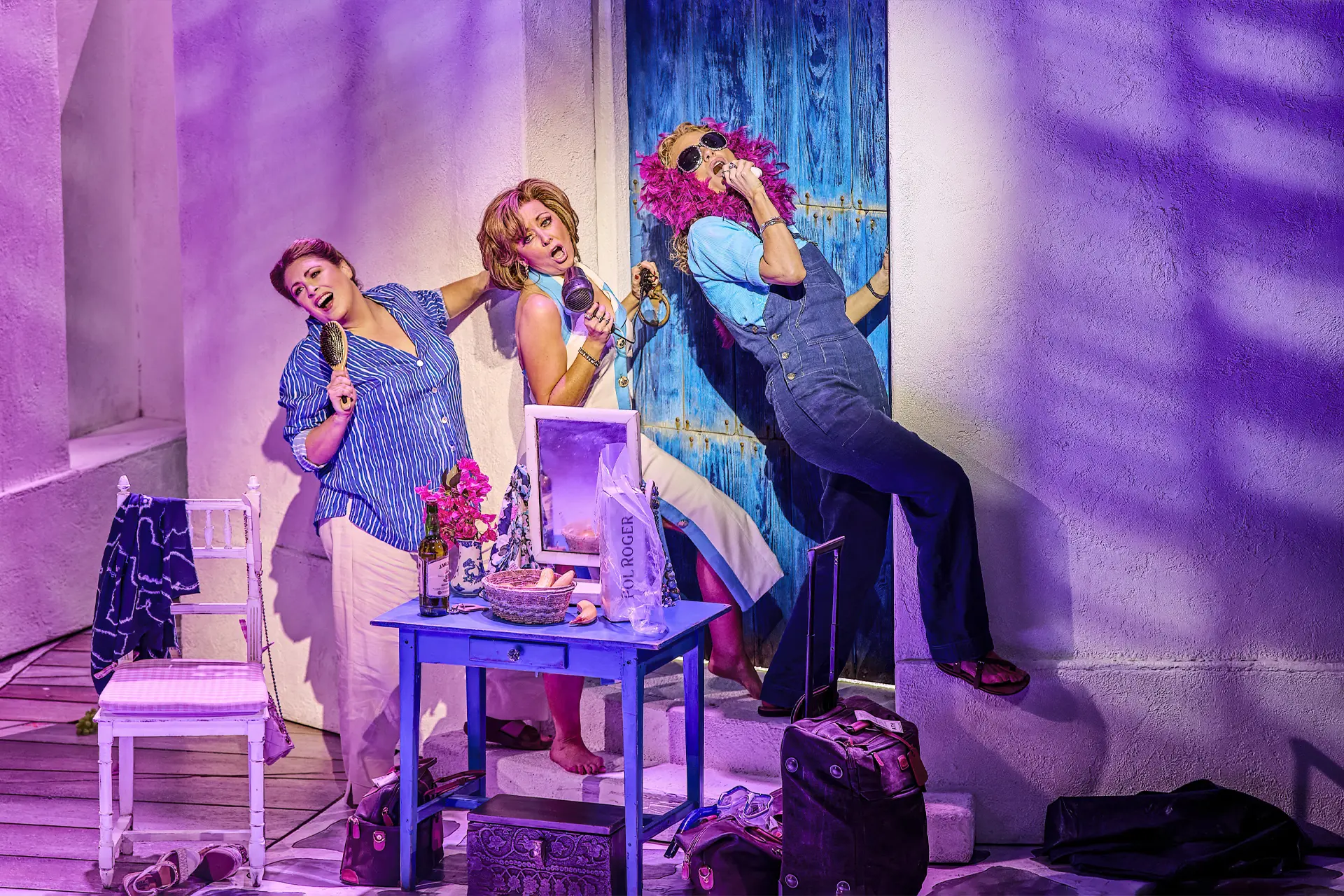
Sarah Earnshaw’s Tanya is every bit as good. The characterisation is strong and the acting excellent, especially in terms of how she holds herself: she has a real presence, and the eye goes to her whenever she is on stage. Lauren Woolf’s Rosie is a brilliant character performance, and what stands out is how hard she works to keep finding new ways to wring humour from the role, rather than coasting on the obvious laughs. Together the three have a wonderful dynamic. Their shared scenes are the richest of the evening, and you sense a real history between these women.
It is worth being honest that the writing for the trio feels forced at the start. The early exchanges can sound stilted, with the script straining to establish who these friends are and what they mean to one another. But the actors find a way forward. Rather than being defeated by thin material, they craft something warm and genuinely engaging from it, which is a credit to the performers rather than the page. By the time the three are properly in their stride, the chemistry has done what the dialogue could not.
The production is at its most confident in the larger dance numbers. Gimme! Gimme! Gimme! has excellent energy and makes great use of the ensemble, who are given the chance to do more here than in other moments of the show. The choreography fills the stage, the company clearly relish it, and the audience responds in kind. It is in these numbers that you feel the full force of a cast working together at pace. Act One closes with that same great energy, and the pacing and execution towards the end of the first half are the best of the night. You head to the interval buzzing, and entirely on side.

Act Two is where things loosen. It is more meandering, and the momentum built before the break is not carried through as it might be. The larger problem is one of connection. The production does not do enough to build a bond between the audience and the characters, so when the show turns towards its more emotional material, it has not laid the groundwork for us to follow. The shift from humour to heartfelt scenes is too stark, and it is most noticeable when you compare Act One with Act Two. Scenes that should land with real feeling can arrive abruptly, as if the show has changed gear without warning. Griffin’s Donna is the great exception, and it is telling that the strongest emotional moments are the ones carried by a single performer rather than by the structure around her.
None of this will stop an audience enjoying themselves, and nor should it. The score is as irresistible as ever, the ensemble are spirited and the three leading women give the show a warmth and credibility that the script alone cannot supply. But a production this experienced, with this much love behind it, could do more to let us in. When the music kicks in and the cast let loose, it is hard not to be swept along; when the show asks us to feel something, it asks a little too suddenly.
Mamma Mia! runs at the Royal Concert Hall, Nottingham, until Saturday 10 October. Tickets are available here.

Photography throughout from Brinkhoff/Mögenburg.
Leave a Reply