
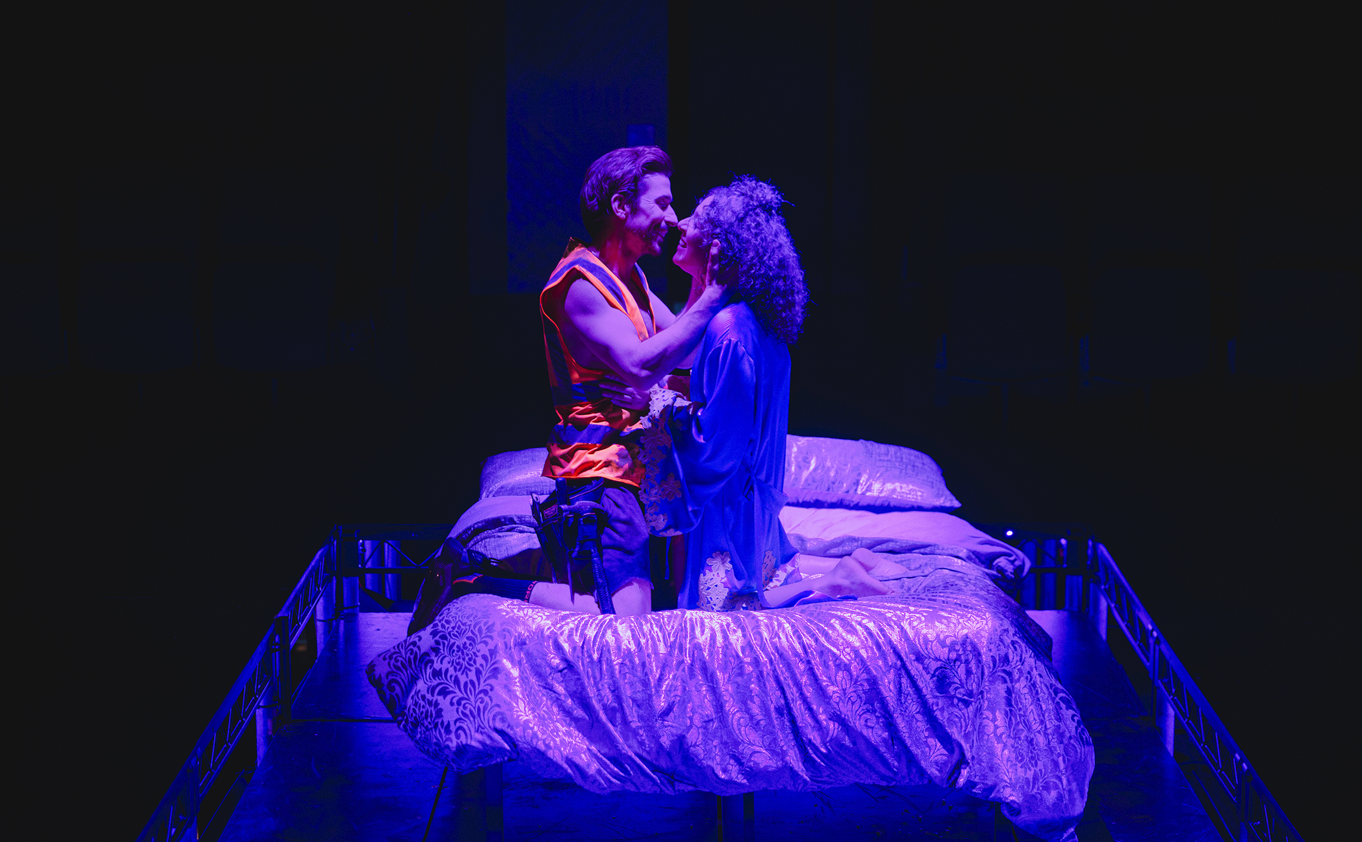
This is an updated and certainly fresh take on Shakespeare’s tragedy, arriving with real ambition but landing unevenly. It follows Not Too Tame’s previous collaborations with acclaim, 2022’s A Midsummer Night’s Dream and 2024’s Twelfth Night, and this marks the company’s first joint production specifically with the New Vic. Award-winning comedian Russell Kane plays Romeo opposite Natalie Casey as Juliet, and the pairing is clearly intended as a headline draw. The cast all work hard to hit the beats the direction clearly wants them to go with, but the production as a whole struggles to reconcile its more interesting ideas with its tonal excesses.
The setting is reimagined within a construction environment, a choice with real potential: the imagery of building, of structures half finished, of danger inherent in the workplace, could have offered a rich visual and thematic throughline for a play about young lives cut short before they’re built. Instead, it’s a creative choice which is never really explored or considered past the first scene. Once the initial scene establishes the world, the concept is essentially abandoned, and the production never returns to interrogate what the setting might mean for the story it’s telling.
Where the production is unambiguously strong is in its design work. The lighting design, from Daniella Beattie, is stunning, and doing this well in the round is a particularly difficult task given the lack of a single fixed sightline to work from; the achievement is more impressive for it. Patch Middleton’s sound design is also great for the most part, and it earns its keep in the play’s atmospheric moments, building tension and mood in ways the script and staging sometimes don’t.
Under Jimmy Fairhurst’s direction, the first half pushes comedy hard and finds some strong wins, suggesting a production confident in reworking Shakespeare’s tonal register for a modern audience. That confidence curdles in the second half, where the show becomes significantly misjudged. The bleaker plot points, the deaths, the grief, the tragedy the play is fundamentally built around, are jarringly juxtaposed with moments of surreal comedy that simply do not land. At points the production feels like a car crash between a traditional Shakespearean play and a pantomime, unable to decide which register it’s actually working in. Compounding this, the text itself is inconsistently handled: scenes are inserted and altered with modernised language, while others play without change in a confusingly machetted version of the script, so the audience is never quite sure whether they’re watching a reinvention or a straight staging.
The clearest example of this failure comes directly after one of the production’s most genuinely affecting moments: the Nurse discovering Juliet’s body and openly grieving her. It’s a scene that, on the evidence of Louise Haggerty’s performance, could have landed with real weight. Instead it is totally undermined by the choice to have members of the audience play instruments as Paris walks in singing “I’m getting married tomorrow.” The scene is then further marred by Paris’s costume, fitted with bells that jingle as he walks around, eliciting laughs from some audience members in what should be a deeply sombre scene. Not content with leaving it there, the production then bafflingly has Peter lead a singalong version of “Always Look on the Bright Side of Life,” played on a kazoo. It’s a sequence of choices that seem to actively work against the emotional register the preceding scene had just earned.
On performances, there’s more to admire. Russell Kane plays a solid Romeo, notably emotional, set against Natalie Casey’s tough-nut Northern Juliet, a characterisation that flips convincingly between edge and softness depending on the scene. Her anger scenes are played particularly well, giving Juliet a bite that’s often missing from softer stagings. Her performance is also bizarrely physical in places; she starts the second half crawling around the stage and pulling herself along the floor, a choice that’s committed even where its purpose isn’t always clear. Casey exhibits clear skill – it’s a real shame that the direction trades some excellent character acting for cheap laughs, especially notable in her comically exclaiming “What’s this?” upon discovering Romeo’s dead body.
Louise Haggerty’s Nurse, referred to throughout as Angelica, does a superb job and has a lovely voice, put to particularly strong use in her rendition of “The Parting Glass” at Juliet’s funeral, one of the production’s few moments where grief is allowed to simply be grief. Andrew Butler’s Peter is given a fairly narrow brief: his sole job in this production is comic relief, and credit is due to the actor for working hard and for genuine skill in working the audience. It’s a shame that skill is so frequently deployed in moments where it’s simply out of place.

David Nellist’s dual role as Montague and Paris is one of the production’s odder swings. His scenes as Montague are bizarre: he becomes a kind of voice in Romeo’s head, taking lines of Romeo’s own dialogue and speaking with some form of omniscience, at one point telling his son that Juliet’s love has made him effeminate. As Paris, now reconceived as a banker rather than a count, he seemingly flirts with Capulet and is played almost entirely for laughs in the second act, a tonal choice that’s totally jarring against the character’s function in the story. Patrick Knowles’s dual role as Tybalt and Friar is a tough ask in its own right, and the doubling isn’t always clear to follow, particularly for audience members less familiar with the text.
Lizzie Hopley’s Capulet is one of the more interesting characterisations on offer: played as beauty obsessed, getting botox in an early scene, while simultaneously conveying what feels like a genuine mother-daughter bond with Juliet. That warmth makes her later outburst and demands that Juliet marry Paris land oddly, since they don’t really square with the strength of the relationship established earlier in the play. Elsewhere, Kieran Foster’s Benvolio and Ray Sesay’s Mercutio, doubling as the Prince, are both played with skill and don’t suffer from the same tonal confusion affecting some of the other roles.
Running at around three hours, including a 20 minute interval, the production is far too long and could easily lose 20 to 30 minutes, likely from some of the comic sequences that overstay their welcome in the second half. The New Vic is an electric venue and so a night here is never wasted, but, sadly, this production needs to head back to the construction yard for some rethinking.
Romeo and Juliet plays at the New Vic until Saturday 10th October 2026. Tickets available here.

Photography throughout from Patch Dolan.

Leave a Reply