
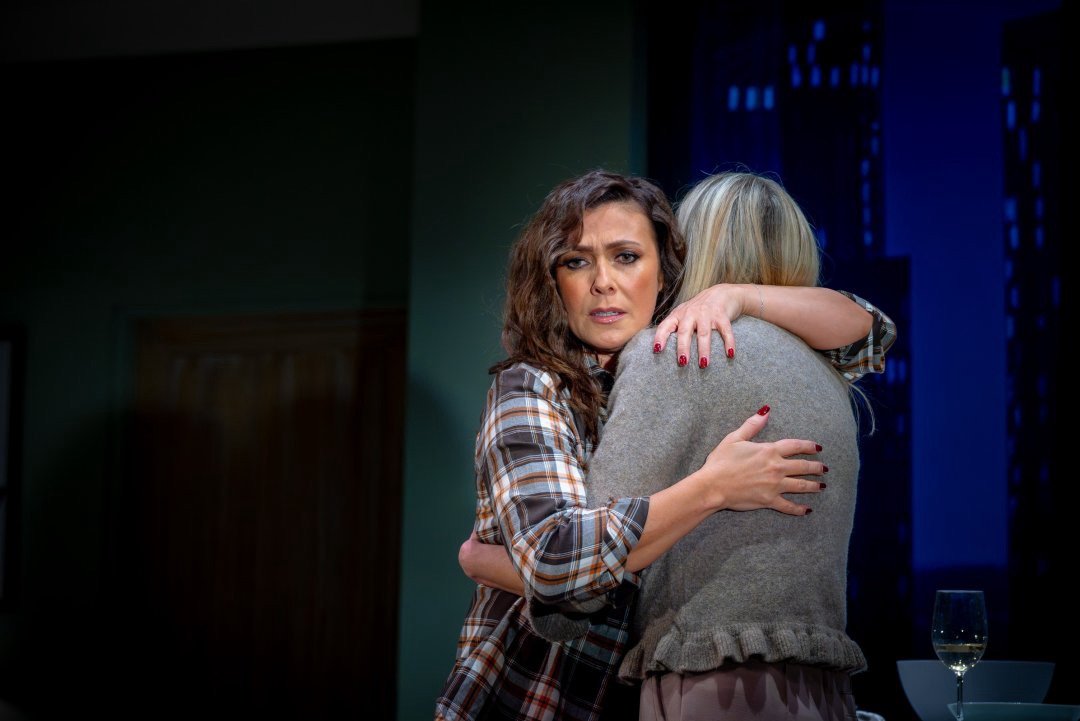
Set firmly in the present day, this stage adaptation updates the classic psychological thriller for the social media age. Allie (Anna Ruben) is a recently divorced mother navigating single parenthood while attempting to launch her own tech start-up. Stretched financially and emotionally, she advertises for a lodger, and into her life steps the seemingly perfect Hedy (Kym Marsh): warm, attentive, and eager to please.
What begins as a mutually convenient arrangement gradually curdles into something far darker. As Hedy’s admiration tips into obsession, she begins mirroring Allie’s life with unsettling precision: her clothes, her mannerisms, her relationships. Allie’s ex, Sam and daughter, Bella are drawn into the orbit of Hedy’s increasingly erratic behaviour, and what appeared to be a lifeline becomes a trap with chilling consequences.
Rebecca Reid’s adaptation of John Lutz’s source material arrives with a clear ambition: drag a nineties thriller into the contemporary moment. It’s a reasonable creative instinct, and the themes of isolation, fractured identity and desperate belonging feel, if anything, more urgent in an age of curated online personas. The problem is that the script too often *tells* us it’s modern rather than embodying it. References to matcha lattes and Labubu figures are dropped in with the self-conscious air of a writer ticking a box, feeling trite rather than grounded. They don’t build a world; they gesture at one.
More frustrating is the lack of genuine character development. Both leads are given clear archetypes to inhabit, but the script rarely trusts them with sufficient depth or coherent motivation. The psychological unravelling at the heart of the story, the reason audiences found the source material so compellingly unsettling, requires us to understand *why* Hedy is the way she is. Here, that why remains frustratingly elusive, leaving the thriller mechanics to operate largely in a vacuum.
When you’re reworking a well-known IP, creative freedom should be an asset. The stage offers possibilities that film cannot: intimacy, spatial tension, the live presence of a performer unspooling before you. That potential is only partially realised. Director Gordon Greenberg keeps things bracingly pacy, and the production’s willingness to move at speed is genuinely to its credit. There is no shortage of propulsion, and audience engagement is maintained throughout. But pace, however confidently handled, cannot fully substitute for the emotional investment that richer characterisation would provide.
Kym Marsh brings a focused intelligence to Hedy. She locates a clear internal logic within a role the script doesn’t always serve, and her physical commitment to the character’s disquieting stillness is well-judged. There’s real craft in her work here, even when the material underneath her doesn’t match it.
On the night, Allie was played by understudy Anna Ruben stepping in for Lisa Faulkner. Ruben handled the role with assurance, establishing Allie’s core traits efficiently and making her sympathetic in a way that anchors the thriller’s stakes, no small feat given that the character is never quite fully realised on the page. Jonny McGarrity as Sam and Amy Snudden as Bella both acquit themselves well in supporting roles, bringing credibility to relationships that the script sketches rather than develops.
Max Pappenheim’s sound design is one of the production’s quiet successes. The score does intelligent work in the background, underscoring tension without overwhelming the performances, and there are moments where the sonic landscape genuinely elevates the drama. Morgan Large’s set is atmospheric and efficiently used, though it does relatively little to shift or evolve over the course of the evening, a single visual environment that, by the later scenes, has begun to feel like a constraint rather than a choice.
Single White Female is a production that works considerably better than it ought to, given the script’s limitations. Its performers are committed and capable, its direction is slick, and it delivers the genre pleasures its audience has come for. But the bones of the story, the genuine psychological strangeness that made the original so memorable, deserved a bolder, more interrogative adaptation. As it stands, this is an engaging night out that stops some way short of being a genuinely unsettling one.
Single White Female plays at the Regent Theatre until Saturday 30th May where it continues its UK tour.

Photography throughout from Chris Bishop.
Leave a Reply