Stephen Sondheim and Hugh Wheeler’s Sweeney Todd: The Demon Barber of Fleet Street tells the story of Benjamin Barker, wrongly transported to a penal colony by the corrupt Judge Turpin so that Turpin could pursue Barker’s wife. Barker returns to London years later under the name Sweeney Todd, consumed by grief and thoughts of revenge. He reunites with Mrs Lovett, the owner of a failing pie shop below his old barber’s rooms, and the two strike up a grim partnership. The show is as much a howl against institutional injustice as it is a horror story, and this Birmingham Rep production leans hard into that reading.
This Birmingham Rep staging is directed by Joe Murphy, designed by Elin Steele, with musical supervision and orchestral reduction by Dr John Rigby, lighting by Rory Beaton, sound by Kelsh Buckman-Drage and musical direction from Leo Munby. Movement is handled by Tinovimbanashe Sibanda, with fights and intimacy by Maisie Carter for MC_Combat, and Robyn Grant serving as associate director. It is a production built on scale rather than spectacle: a band reduced to just seven players, an ensemble of eleven doing the work of a much larger company, and a cast fronted by genuine musical theatre heavyweights in Ramin Karimloo and Meow Meow. That combination, a small band, a lean ensemble and starry leads, shapes the whole evening. This is a chamber, expressionistic Sweeney rather than the lavish West End spectacle some audiences might be expecting, and for the most part that choice pays off handsomely.
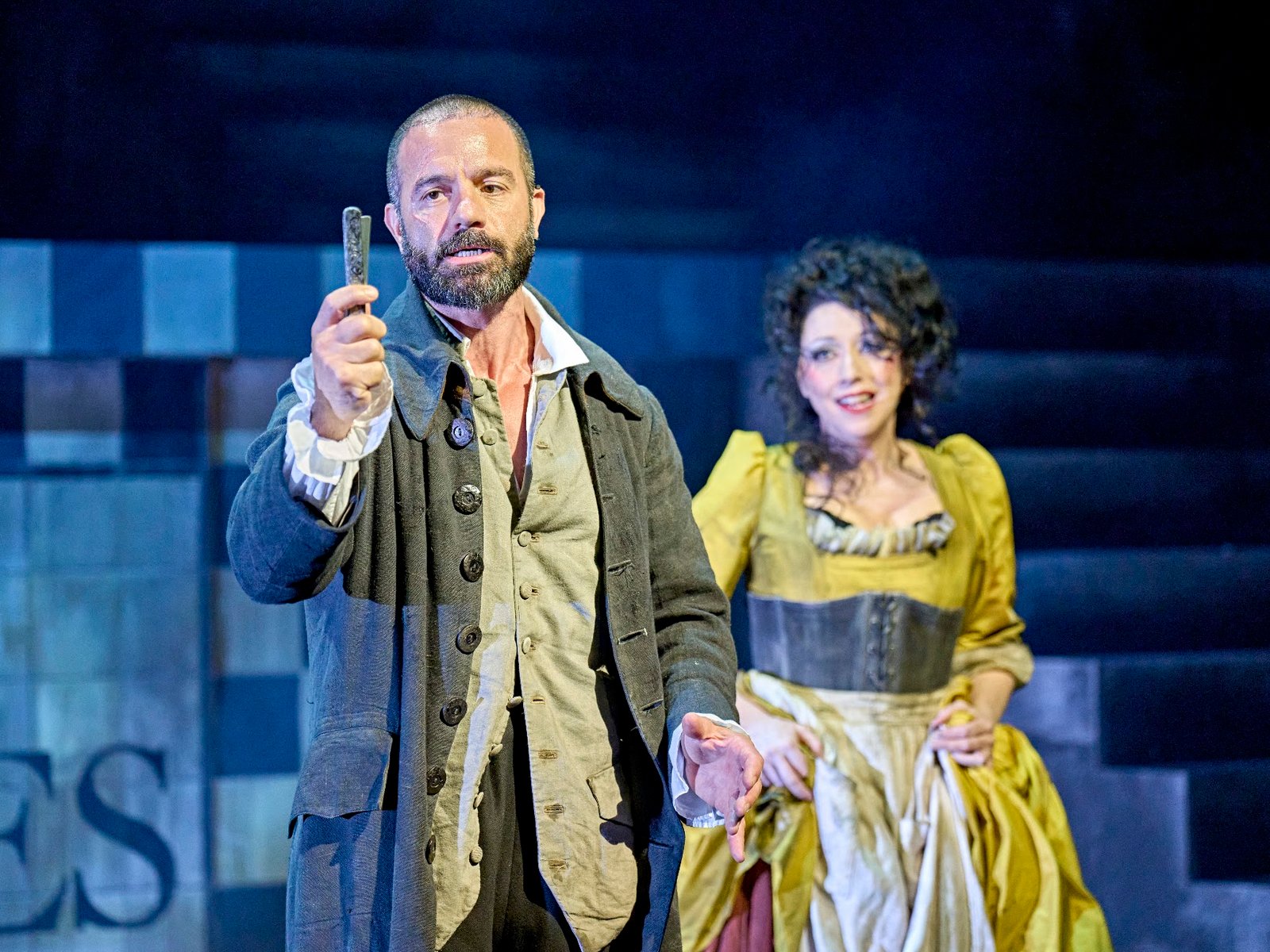
Ramin Karimloo anchors the production as Sweeney, and on the strength of this performance alone the ticket price is justified. His Sweeney is a man hollowed out by grief: cold, detached, emotionally vacant in his quieter moments, haunted visibly by the ghosts of his past, and then driven by fury the second that composure cracks. It is a performance built on contrast, the stillness before the violence, and Karimloo sells both ends of that spectrum completely. Vocally he is on tremendous form throughout, but it’s his Epiphany that stands as the genuine highlight of the night. It is intensely, psychologically believable as the portrait of a man utterly destroyed by injustice, and it is delivered with such ferocity and control that it comes close to earning a mid-show standing ovation. Few things in the West End or beyond currently match it.
Meow Meow is a superb Mrs Lovett, and the choice to play her delightfully unhinged rather than merely comic pays off again and again. She is very funny, always slightly off-kilter, and that unpredictability keeps the character’s darker beats from ever tipping over into straightforward misery. There’s a live-wire quality to her that makes Lovett feel genuinely dangerous in her own right, rather than simply Todd’s accomplice.

David Bedella brings real menace to Judge Turpin, cold, controlled and thoroughly convincing as a man whose respectability barely conceals his rot, though some of the production’s other authority figures lean more towards pantomime than Bedella’s more grounded, unsettling read on the role.
Julius D’Silva steals every scene he appears in as a flouncing Beadle, all fussy self-importance and sudden menace. Alongside Bedella he does a huge amount of work expanding the world of the piece beyond just Todd and Lovett, and his comic timing and rapid shifts in mood repeatedly reset the tone of a scene in an instant, which is exactly the kind of texture this show needs to stop the horror becoming monotonous. Shem Omari James brings a wonderful voice and naive enthusiasm to Anthony, excelling in a demanding lead role while also pulling serious weight in the ensemble elsewhere in the evening. He and Jo Stephenson, as Johanna, sing together with real tenderness, and their scenes provide a genuinely necessary counterweight to the darkness surrounding them. Silas Wyatt-Barke also deserves particular credit as a vocally assured Pirelli, milking every ounce of comic grandiosity from a small but memorable role.
The ensemble as a whole works hard and works well, but the modest size of eleven does eventually show. With so few bodies covering so many roles, several of the lead performers reappear repeatedly in ensemble parts, and that doubling occasionally becomes distracting rather than seamless. At one point, Jack Gibson (Tobias) reappears moments later as a gentleman visiting the barber’s shop, recognisable as Tobias in everything except his brown jacket, and moments like this pull focus away from the story at exactly the wrong point. A slightly larger ensemble would iron out these quick changes and let the doubling recede further into the background, where it belongs.
Accent work across the company could also use more cohesion. Sweeney comes through with something closer to a Canadian lilt, Lovett channels a Mrs Potts-esque Londoner, and Tobias is played with a distinctly northern accent, and taken together the overall effect needed tightening up, at least among the characters who share the most stage time with one another. It’s a small issue against everything the production gets right, but it is noticeable once you start listening for it.
The design is where this production really announces itself, and it is genuinely one of the most striking Sweeney Todd sets in recent memory. The overall aesthetic is brutalist and expressionistic, built heavily around the idea of the law as an oppressive, looming presence. A three-storey granite structure dominates the stage, and a large Lady of Justice looms above the action throughout, lit so beautifully that the shadows cast by her sword and scales fall across the set or her face becomes obscured into a formless shadow in a way that visually ties the whole evening back to its themes of institutional corruption and injustice. It is a set that does thematic work rather than simply providing a backdrop, and Elin Steele deserves enormous credit for a design that manages to be both imposing and genuinely beautiful. Dark blacks creep up from the base of the walls before fading gradually into whiter shades higher up, and several of the ensemble costumes pick up that same gradient, tying the performers visually into the fabric of the world Steele has built rather than leaving them to sit in front of it.
Rory Beaton’s lighting design is atmospheric throughout and does an enormous amount of the storytelling on its own, drawing the audience in scene after scene and giving the granite set its full dramatic weight. It’s lighting that shapes mood as much as it illuminates action, and it is one of the genuine triumphs of the evening. The sound design and musical direction are both close to perfection. With the band reduced to a mere seven players, an unusually lean number for a score this demanding, the sound that emerges is still full and rich, and a great deal of credit for that has to go to Leo Munby’s musical direction and Dr John Rigby’s orchestral reduction. It’s also a lovely touch that the musicians are lit and visible throughout rather than buried away off-stage, which lets the audience feel the presence of the band as part of the world of the piece rather than as a hidden mechanism behind it.
Not every choice lands quite as well as the design and sound. A handful of supporting roles are played in a broadly pantomime style, and while that can work well in isolated moments of comic relief, it occasionally detracts from the horror elsewhere in the production and sits slightly awkwardly against the more grounded, unsettling performances from Karimloo and Bedella.
Overall, this is a Sweeney Todd built on a genuinely exceptional central performance, a set and lighting design that are thematically rich and visually stunning, and a band and sound team punching well above what a seven-piece ensemble should reasonably achieve. This production is atmospheric, intelligent and thoroughly memorable, and it stands as one of the more thoughtful stagings of this show to come along in some time.
Sweeney Todd: The Demon Barber of Fleet Street plays at The Rep until Saturday 15th August 2026. Tickets available here.

Photography throughout from Manuel Harlan.
Leave a Reply