
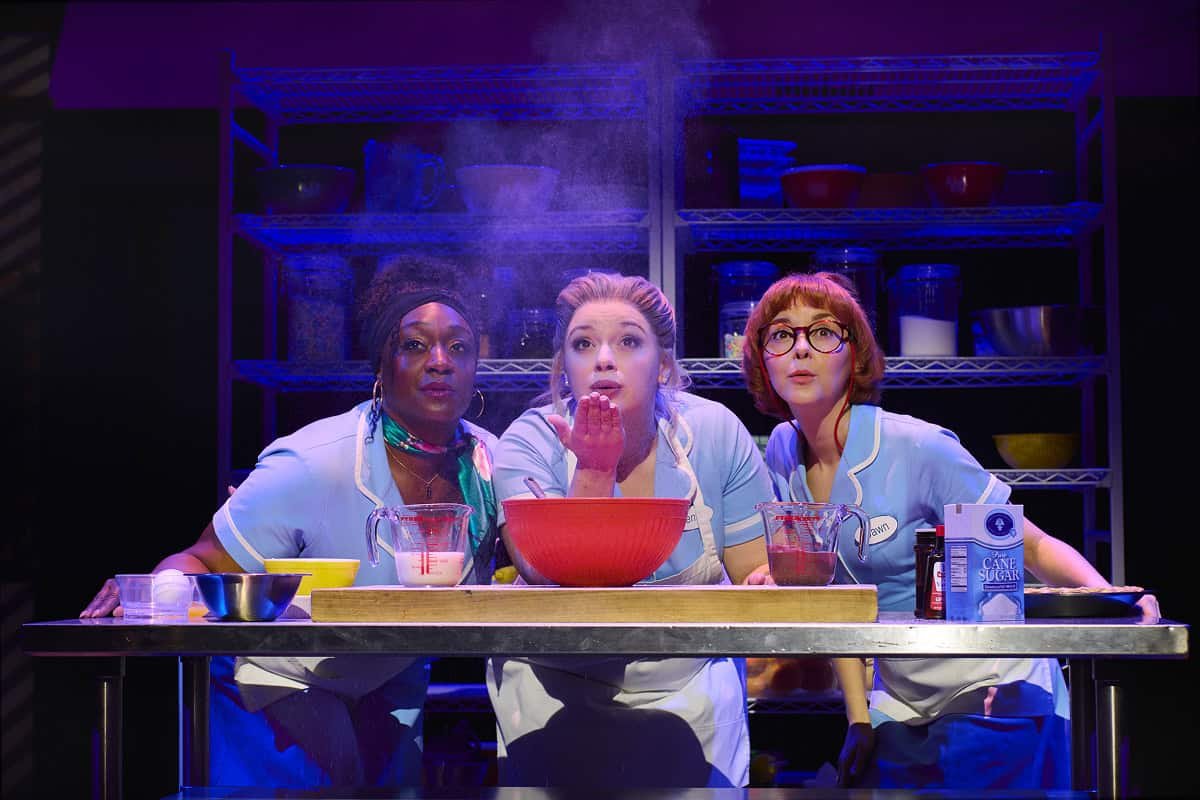
Ten years after it first opened on Broadway, Waitress rolls into Nottingham this week as part of its ongoing UK and Ireland tour, bringing Sara Bareilles’ warm, pie-obsessed score to the Royal Concert Hall stage. Before getting into how this production stacks up, it’s worth setting out what the show is actually about and where it’s come from.
Jenna is a waitress and a genuinely gifted pie maker, stuck in a small town and an even smaller marriage. Her husband Earl is controlling and unpleasant, and when Jenna discovers she’s pregnant, the prospect of motherhood only sharpens her sense that she’s trapped. A local pie-baking contest, with a life-changing cash prize, gives her a flicker of hope for escape. Around her, her fellow waitresses Becky and Dawn wrestle with their own romantic entanglements. It’s a show that wants to be about self-worth, friendship and the courage to choose a different life, all wrapped in an awful lot of pie metaphors.
Waitress began life as a 2007 film written by Adrienne Shelly, and was adapted for the stage with music and lyrics by Sara Bareilles and a book by Jessie Nelson, directed by Diane Paulus and choreographed by Lorin Latarro. It opened on Broadway in April 2016 and ran until January 2020, before transferring to London’s Adelphi Theatre in March 2019. A decade on, it has become a genuine global property, with productions across North America, Japan and the Netherlands, French and Spanish language versions, and an Australian production opening this year. This current tour marks its journey around the UK and Ireland, and this week it’s at the Royal Concert Hall in Nottingham.
Carrie Hope Fletcher is excellent throughout, and genuinely one of the best reasons to see this production. She’s wonderful, a total joy to watch, and she has one hell of a voice, controlled and conversational in the quieter, confessional numbers before being let loose fully when the score demands it, with a belt that fills the auditorium without ever tipping into strain. But it’s the nuance in the performance that really lifts it above simply being a great sing. You can feel the cumulative weight of the scenes building on Jenna across the evening, small moments of exhaustion and quiet resignation stacking up so that the performance feels genuinely layered rather than just a sequence of strong vocal set pieces. There’s real depth to the role as Fletcher plays it, and by the time she reaches her big Act Two numbers the emotion feels properly earned rather than simply cued up by the orchestration.

Evelyn Hoskins as Dawn is a total scene-stealer. She’s brilliant, and finds a truly believable way into a character who could very easily become a cartoon in less careful hands. Dawn is written as the show’s resident oddball, all nervous energy and social awkwardness, and Hoskins embodies her so completely that the character never feels like a device or a punchline. Instead she grounds Dawn’s eccentricity in something recognisably real, so the comedy lands because it’s rooted in truth rather than caricature, and her scenes opposite Ogie are among the most purely enjoyable in the whole show as a result.
Mark Anderson’s Ogie is another highlight. It’s a tricky part to get right, an oddball suitor whose persistence could easily read as charming or as genuinely unsettling depending on the choices an actor makes, and the West End production leaned towards stunt casting the role, bringing in names for novelty value rather than for what they could bring to the character itself. It’s genuinely pleasing to see this touring production avoid that trap. Anderson finds real nuance here rather than playing Ogie as a single joke, building a performance that’s hilarious and, eventually, deeply endearing. Dan Partridge, meanwhile, does a great job as Dr Pomatter, playing him with such fumbling, genuine warmth that he comes across as thoroughly loveable rather than predatory, despite being a married man conducting an affair with a patient. Les Dennis is also in this production as Joe.
That said, it’s worth naming something the show itself never quite does: pretty much every man in this story is problematic in some way, from Earl’s controlling nastiness to Ogie’s obsessive tendencies to Pomatter’s affair with a patient, and the production doesn’t really get into that. It skates past rather than examines it, and the effect is that the female empowerment and friendship at the heart of the piece doesn’t always bloom as fully as it might, even though the men around these women are so clearly the source of a lot of their unhappiness. Jenna, Dawn and Becky are given moments of solidarity and warmth, but the show seems more interested in resolving each woman’s romantic subplot than in properly interrogating what’s been done to them along the way.
The ensemble is a genuine weak point here. The show simply doesn’t seem to know what to do with them, and they’re poorly used throughout, drifting in and out of scenes without ever feeling essential to the storytelling, and leaned on heavily to physically shift set pieces between locations rather than contributing much dramatically or choreographically. Lighting and set design is a much stronger element, doing excellent work to contrast the warmth and brightness of the diner with the claustrophobia of Jenna’s home life and her release during She Used to be Mine.
Pace is the other issue that runs through this production. It moves very quickly, and we don’t sit in scenes for very long at all before we’re swept on to the next one. That keeps the energy up, but it also means we brush past an awful lot without it being properly developed, characters, relationships and themes alike, leaving some of the emotional groundwork feeling thinner than it should.
Even with those reservations, this touring production of Waitress has plenty going for it: a lead performance from Carrie Hope Fletcher with real depth and layering, a scene-stealing Dawn from Evelyn Hoskins, a genuinely well-judged Ogie, and lighting that does a lot of quiet, effective work.
Waitress plays at the Royal Concert Hall in Nottingham until Saturday 15 August, before continuing its run around the UK and Ireland.

Photography throughout from Matt Crockett.
Leave a Reply