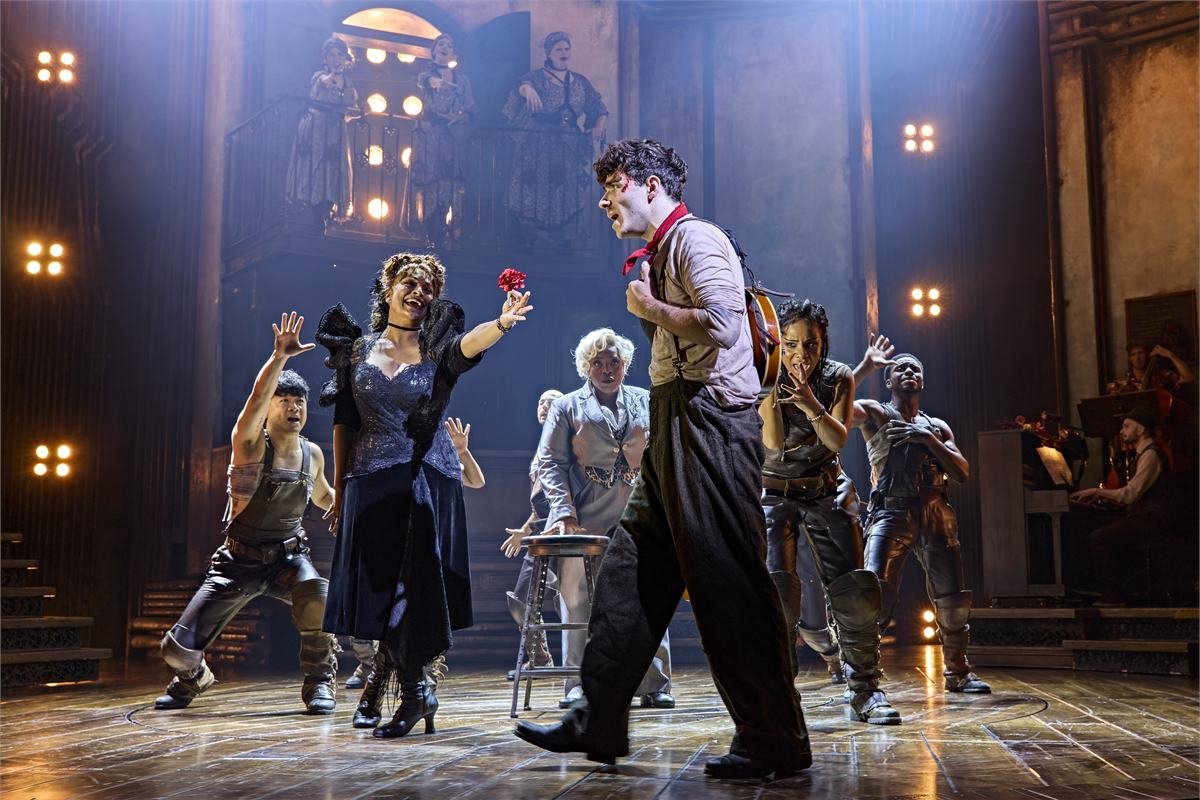
Spring has come again as Hadestown welcomes a new cast for the second half of its third year in London. With a stellar new cast and a hypnotically beautiful score, Hadestown remains the jewel in the crown of musical excellence in the West End; it is not only a theatrical spectacle but also a testament to the rich tapestry of British talent. The production seamlessly weaves together elements of ancient Greek mythology with modern storytelling, all while showcasing the diverse range of accents and cultural influences that define contemporary Britain. Now a firmly established hit in the West End, this cast proves there is still so much life in this production which goes from strength to strength. It feels so fresh, so alive even years after its West End arrival.
Hadestown is a captivating musical that intertwines two mythic love stories against the backdrop of a post-apocalyptic world. Set in the underworld ruled by the enigmatic Hades and his wife Persephone, the narrative follows the journey of Orpheus, a gifted musician, as he descends into the depths of despair to rescue his beloved Eurydice. Along the way, the audience is immersed in a world where gods and mortals collide, where love and redemption are sought amidst the darkness, and where hope and despair dance in a delicate balance. Through its mesmerising music, compelling characters, and timeless themes, Hadestown invites audiences to contemplate the power of love, the resilience of the human spirit, and the eternal struggle between light and shadow.
Malinda Parris leads the cast with plenty of vocal flair as Hermes, bringing a fun and funky energy to the role that keeps the storytelling light on its feet without ever losing its authority. Her facial expressions are a constant delight, wringing humour and warmth from lines that could easily become rote after so many retellings, and she wears the narrator’s mantle with an easy, knowing charm. Vocally she is assured throughout, comfortable across the score’s jazz-inflected demands and unafraid to lean into its playful syncopations. Her Hermes feels less like a stern guide and more like a mischievous conductor, delighted to be steering the story along, and it is this playful spirit that sets the tone for the whole evening.

Nathan Sykes brings a fantastic, powerful voice to Orpheus, full of real grit and force that sits in fascinating tension with a performance built on nervous energy and giddy awkwardness. Rather than undercutting the character, this contrast is the making of it: his Orpheus is visibly unsure of himself in the world, fidgety and endearingly gauche, until the music takes over and he is transformed into something stronger and more confident. That journey, from awkward dreamer to a man made whole by his own art, is charted vividly across the show, and Sykes’ vocal power ensures the musical moments land with real force even as the dramatic scenes stay tender and small.
Fayth Ifil offers a beautiful voice and a beautifully poignant performance as Eurydice, finding real tenderness in a role that can sometimes tip into simple naivety. Her tone is warm and clear, and she uses it with real sensitivity in the quieter passages, letting the poignancy of Eurydice’s choices shine in a remarkably beautiful ‘Flowers’. There is a quiet dignity to her performance, a sense of a young woman making an impossible decision out of desperation rather than foolishness, and it is this groundedness that gives her scenes with Orpheus their emotional weight.
Danielle de Niese brings a sublime voice and a wonderful blend of joy, regret and pain to Persephone, and it is her reactions, often wordless, that mark her out as a particularly layered interpreter of the role. She lets the character’s warmth and mischief spill out freely in the opening scenes, then allows the cracks of exhaustion and old hurt to show through with real subtlety as the story darkens. Her operatic pedigree is evident in the control and colour she brings to the score, but never at the expense of the character’s earthiness; this is a Persephone who feels lived-in, weary of the underworld’s rigidity, and grateful for every stolen moment of spring.
Shaun Dooley is a revelation as Hades and delivers what could be described as a definitive performance. His gorgeous bass-baritone voice is exceptional and harks beautifully back to Patrick Page, filling the theatre with a weight and menace that never tips into caricature. His characterisation, anger and power are phenomenal, and his rendition of ‘Why We Build the Wall’ is perhaps the strongest yet seen in this production, delivered with such force that the audience felt compelled to start clapping before the song had even finished. There is a rage and pain at the heart of his Hades that never quite resolves, and his performance carries an excellent connection with de Niese’s Persephone, the two of them charting a long, complicated marriage in a handful of scenes with real clarity and hurt.

The Fates, Melanie Bright, Lauran Rae and Spike Maxwell, remain precise, controlled and deeply atmospheric. Their vocal blend is exceptional, achieving a tight harmonic unity that feels both polished and unsettling. They operate almost as a single entity, yet each performer brings subtle individuality through physical detail and tonal variation. Their movement is fluid and intentional, often mirroring or counterpointing the action in ways that heighten tension. What stands out is their consistency: every entrance feels purposeful, and their presence maintains a constant undercurrent of inevitability. They do not simply comment on the action, they shape it.
The Workers, portrayed by Gabriela Benedetti, Femi Akinfolarin, Lindo Shinda, Ollie Bingham and Sebastian Lim-Seet, deliver a cohesive and physically demanding ensemble performance that underpins the entire production. Their movement is sharp, synchronised and rhythmically precise, reflecting the industrial world they inhabit. Vocally, they provide a strong, unified sound that contrasts effectively with the more individualised performances of the principals. In moments where they sing individually, it’s beautiful to hear a real range of accents reflecting the production’s freedom of personal expression. What is particularly effective is their ability to maintain character within ensemble work: each performer contributes to a collective identity while still suggesting individuality through physical choices and energy. Their presence is essential in grounding the production’s themes of labour, control and resistance, and they execute this with clarity and conviction.
Anaïs Mitchell’s lyrics are nothing short of poetic, weaving together intricate storytelling with rich imagery and metaphor. Each song is a masterpiece in its own right, conveying complex emotions and themes with haunting beauty. Mitchell’s ability to capture the essence of the human experience is truly remarkable, and her lyrics serve as the beating heart of the production.
The creative team behind the West End production of Hadestown is a powerhouse of talent, each member contributing their expertise to bring Anaïs Mitchell’s visionary project to life on stage. Led by director Rachel Chavkin, the team has crafted a production that seamlessly blends mythic storytelling with contemporary sensibilities, creating a theatrical experience that is both timeless and relevant.
Chavkin’s direction is masterful, guiding the cast and crew with precision and insight to create a cohesive and immersive world onstage. Her ability to balance the epic scope of the story with intimate character moments is evident throughout the production, drawing audiences into the emotional journey of the characters.
Choreographer David Neumann’s work adds an extra layer of dynamism to the production, with his inventive and evocative choreography bringing the world of Hadestown to life in stunning detail. From the haunting movements of the Fates to the vibrant energy of the Workers, Neumann’s choreography enhances the storytelling and adds depth to the characters.

Set designer Rachel Hauck’s vision transforms the stage into a multi-dimensional underworld, with her intricate and innovative designs creating a sense of grandeur and intimacy simultaneously. Her use of space and texture adds depth and richness to the production, transporting audiences to a world that is both fantastical and familiar. The descents and ascents to the underworld are portrayed masterfully and demonstrate an incredible use of staging and set.
Costume designer Michael Krass’s work is equally impressive, with his stunning costumes reflecting the characters’ personalities and the world they inhabit. From the elegant attire of the gods to the rugged garb of the Workers, Krass’s designs help to define the characters and enhance the overall aesthetic of the production.
Lighting designer Bradley King’s contributions are also crucial to the production, with his expert use of light and shadow creating mood and atmosphere onstage. Many moments in the show allow you to truly appreciate this wonderful lighting design, injecting energy at some points and inflicting emotion at others. Shadows are thrown onto the wall as light hits characters in atmospheric moments. The intensity of the lighting in other moments is startling.
Overall, Hadestown is a theatrical tour de force that captivates audiences from start to finish. With its stunning visuals, mesmerising music, and powerhouse performances, it is a testament to the enduring power of storytelling and the boundless creativity of the human spirit. It is still a must-see production for fans of musicals, love stories or a high-quality night out.
Hadestown plays at the Lyric Theatre, London and is currently booking up until December 2027.

Photography throughout from Brinkhoff-Moegenburg.
Leave a Reply